Tools & budgets
Beginner Maker Tool Budget: What to Buy First
Updated June 11, 2026
The expensive mistake isn't buying the wrong machine — it's buying machines in the wrong order, before the boring gear that makes them usable. Here are three honest budgets, each one complete and project-capable, with the upgrade path between them.
Some links on this page are affiliate links. If you buy through them, The Maker Guide may earn a small commission at no extra cost to you. We only point at product categories we would compare ourselves. Details.
The ordering rule
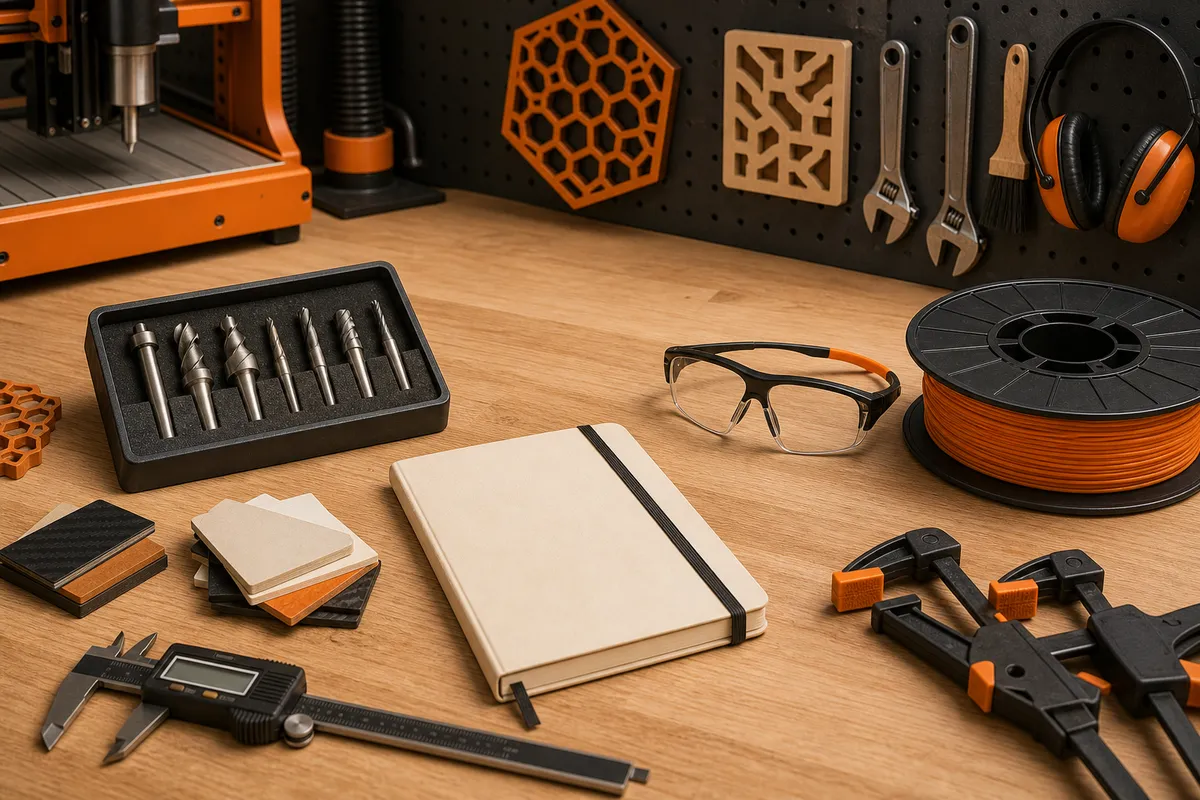
Spend in this order: safety → measurement → workholding → the machine → its accessories. Every tier below follows it. Reversed — machine first, everything else 'later' — produces the classic garage tableau: a CNC on a wobbly table with two clamps, no dust collection, and a frustrated owner shopping for a better machine to fix problems $80 of accessories would solve.
Tier 1 — $300: prove you'll actually make things
No machine at this tier — this is the bench every machine later depends on: safety glasses and hearing protection (~$40), digital calipers (~$25), a cordless drill if you somehow lack one (~$70), clamps in two sizes (~$40), a quality knife/square/marking set (~$45), and a first project's materials (~$60).
The honest companion move at this tier: make your machine projects at a makerspace. Membership at a space like The Makr Lab costs less monthly than machine depreciation, includes the training, and tells you which machine your projects actually want — which is the whole question tier 2 has to answer.
Tier 2 — $1,000: the first machine, fully equipped
Tier 1 plus one machine bought complete: either a 10–20 W diode laser with enclosure, exhaust, air assist, and rated glasses (~$700 all-in), or a budget-stretched 4040 CNC with bits, clamps, and dust gear (~$800–900 all-in), or a quality 3D printer with two spools and a hardware kit (~$400–600, the cheapest complete setup).
Which machine? CNC vs laser and CNC vs printer cover the decision — the one-line version: printer for functional parts, laser for flat personalization, CNC for carved depth. One machine, equipped, beats two machines, bare.
Tier 3 — $2,500: the two-machine shop
The proven pattern: a 3D printer plus either a well-equipped 4040-class CNC or a serious laser setup — the printer makes jigs, organizers, and adapters for whichever big machine you choose, and they compound. Add a real workbench with clamping, a shop vac with cyclone, and material stock.
What tier 3 deliberately skips: the $2,000+ single machine. A Shapeoko-class purchase is the right call only once projects — ideally revenue — demand it. Capability spread beats capability depth until you know your lane.
Budget summary
| Tier | Total | Machines | You can make |
|---|---|---|---|
| $300 | Bench + hand tools | None (borrow/makerspace) | Anything, slowly — and you'll learn what machine you want |
| $1,000 | Tier 1 + one equipped machine | Printer, laser, or CNC | A real product line in one process |
| $2,500 | Two-machine shop + real bench | Printer + CNC or laser | Multi-process projects; small-business capable |
The tier-1 core, linked
Safety starter: glasses + ear protection
First purchase, every tier assumes it, no machine without it.
See options on Amazon →Digital calipers
The measurement habit that makes every later machine accurate. Buy once, use forever.
See options on Amazon →Clamp assortment (bar + spring)
The 'never enough clamps' cliché is a budgeting instruction.
See options on Amazon →Combination square + marking knife
Layout accuracy costs $40 and upgrades every project regardless of which machines come later.
See options on Amazon →Frequently asked questions
What's the best first machine for a maker?
A 3D printer, for most people: cheapest complete setup, safest indoors, runs unattended, and it makes accessories for whatever machine comes second. The exceptions: if your projects are clearly flat-and-personalized (laser) or carved wood (CNC), buy your actual lane.
Should I buy used maker tools?
Hand tools and shop vacs: absolutely. Machines: used 3D printers and CNCs from upgrading hobbyists are often excellent value — ask to see a part made while you watch. Used lasers deserve more caution (tube wear on CO2, sketchy wiring on modified diodes).
How much should I budget for materials versus tools?
Beginners reliably under-budget materials 10:1. Plan $30–60/month of consumable stock from day one — the maker who practices on cheap poplar and basswood improves faster than the one guarding two precious walnut boards.