Tool guide
Maker Safety Gear: The $150 That Protects the Only Irreplaceable Equipment
Updated July 7, 2026
Hobby machines ship with the safety story underplayed: MDF dust is a carcinogen, a router-plus-vac session exceeds OSHA noise limits, and 450 nm laser reflections blind faster than a blink. None of this argues against the hobby — it argues for $150 of gear chosen by actual risk, worn with actual consistency.
Some links on this page are affiliate links. If you buy through them, The Maker Guide may earn a small commission at no extra cost to you. We only point at product categories we would compare ourselves. Details.
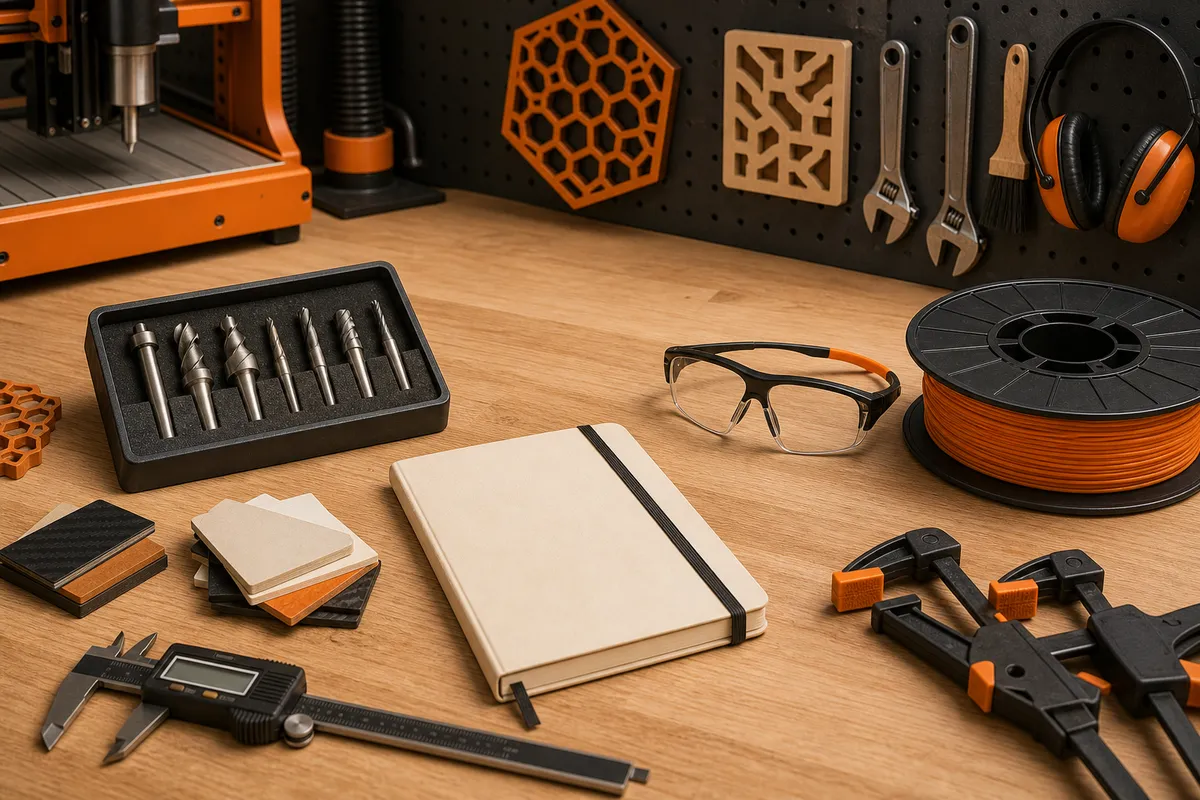
Ranked by real risk, not by drama
| Risk | Source | Consequence profile | The gear |
|---|---|---|---|
| Fine dust | CNC/sanding MDF & hardwood | Cumulative, invisible, decades-later | P100 respirator + collection at source |
| Eyes — impact | Router chips, cutoff wheels, wire wheels, snapped bits | Instant, permanent | Z87+ glasses that live on your face |
| Eyes — laser | Diode/CO2 reflections | Instant, permanent, painless at the time | OD-rated goggles matched to wavelength |
| Hearing | Router + shop vac (95–105 dB combined) | Cumulative and permanent — tinnitus is forever | Muffs or plugs, NRR 25+ |
| Fire | Lasers, dust + sparks, resin/finishing solvents | Rare, catastrophic | ABC extinguisher + smoke detector + habits |
| Skin/chemical | Resin, epoxy, solvents, leather dyes | Sensitization is cumulative and permanent | Nitrile gloves, box of 100 |
Lungs: the one that gets underestimated
Wood dust — especially MDF's resin-loaded flour and hardwoods like walnut — is the shop's slowest hazard: the particles that matter are the ones you can't see, and the bill arrives in decades. The hierarchy is source-capture first (dust shoe, vac, separator), respirator second: a P100 half-mask ($25–35) filters 99.97% and, crucially, is comfortable enough to actually stay on through a spoilboard surfacing session. Disposable N95s are the acceptable minimum for light sanding; the half-mask is the real answer for MDF days, resin printing sessions (with organic-vapor cartridges), and spray finishing.
3D printing gets its honest sentence: PLA in a ventilated room is a non-issue for most people; ABS/ASA and resin want an enclosure vented outdoors or a filtered box — the same ventilation logic as lasers, at lower stakes.
Eyes and ears: the instant and the gradual
Impact: buy Z87+ rated glasses comfortable enough to forget — comfort is compliance, and the $12 anti-fog pair worn beats the $40 pair in the drawer. Prescription wearers: OTG (over-glasses) styles or prescription safety glasses, not optimism. The moments that demand them are exactly the casual ones: 'one quick cut' with the rotary tool, clearing a CNC jam, wire-brushing rust.
Noise: a trim-router CNC with shop vac runs 95–105 dB — permanent-damage territory in under an hour per day. Electronic muffs ($30–60) are the maker's pick: protection plus conversation and machine-sound awareness (you want to hear the cut change). Foam plugs (NRR 29+) cost pennies and work if inserted right; a jar of them by the door is good shop furniture.
Laser: goggles rated for your wavelength at OD4+ — 450 nm for diodes, 10,600 nm for CO2 — and the discipline that enclosures don't replace them around open-frame machines. The included freebies are tinted plastic, not protection.
The complete kit (~$150)
P100 half-mask respirator (3M 6000/7500 series class)
The lungs line-item: silicone seal, replaceable P100 filters, organic-vapor cartridge option for resin and finishing. Fit matters — shave-day seal checks are real.
See options on Amazon →Z87+ anti-fog safety glasses, 3-pack
One at each machine, because gear within reach is gear that gets worn. Anti-fog coating is the difference between wearing and 'wearing.'
See options on Amazon →Electronic hearing protection muffs
NRR 23–25 with mics that pass speech and cut at the threshold: router sessions stop costing hearing, and you still hear the bit start chattering.
See options on Amazon →Laser safety goggles rated for your machine
Match the wavelength (450 nm diode / 10,600 nm CO2) and demand a printed OD rating. Per-person, not per-shop, if others watch the machine run.
See options on Amazon →ABC fire extinguisher + smoke detector for the shop
Mounted at the exit path, not behind the machines. The laser corner earns its own detector; a $60 thermal camera check of suspect wiring is bonus points.
See options on Amazon →Nitrile gloves, box of 100
Epoxy, resin, dyes, finishes, and solvents all share one rule: sensitization is cumulative, and gloves are how it never starts. Cheap enough to change mid-job.
See options on Amazon →Habits that gear can't replace
- Attend the machines that need attending: lasers always, CNC nearly always, printers via smoke detector and camera. The fire that gets big is the one nobody watched start.
- Dust discipline is fire discipline: fine dust in a bin with a spark or hot metal fragment is how shops burn down slowly, then quickly. Empty separators, don't vacuum hot metal swarf into wood-dust bins.
- Sound in the shop is information: a bit that starts screaming, a vac that goes muffled, a print that goes clattery — muffs that pass speech let you keep the channel open.
- One-way doors: eye and hearing damage don't heal, sensitization doesn't reverse. The gear exists because there's no undo.
- Teach visitors the rules before the tour — goggles for the laser corner, glasses by the CNC. A makerspace's safety orientation is worth copying at home; watching how The Makr Lab runs its floor is a free education in shop culture done right.
Frequently asked questions
What safety gear do I need for a CNC router?
Safety glasses always (bits snap and throw carbide), hearing protection whenever the router and vac run, and a P100 respirator for MDF and long hardwood sessions even with dust collection — the shoe catches most of it; 'most' is the operative word. Total: about $90, less than one good bit set.
Do I really need laser goggles if my laser has an enclosure?
A genuinely interlocked, properly-windowed enclosure (the amber acrylic is wavelength-specific by design) makes goggles optional during normal enclosed operation. Open-frame machines, lid-open alignments, and 'the interlock is taped' situations make them mandatory. Most hobby diode setups are the second category more often than owners admit.
Is a dust mask the same as a respirator?
No: a nuisance-dust mask blocks visible dust and little else; an N95 filters 95% of the fine stuff with a marginal seal; a fitted P100 half-mask filters 99.97% with a real seal, and cartridge options add solvent/VOC protection. For MDF, walnut, and resin work, the half-mask is the honest tool at $30.
What kind of fire extinguisher for a maker shop?
A 5 lb ABC dry-chemical covers wood, solvents, and electrical — mount it at the exit, not deep in the shop. Laser owners: a small CO2 extinguisher is a nice adjunct (no powder mess for small in-machine flare-ups), but ABC is the requirement. Check the gauge annually; they quietly retire themselves.
Are 3D printer fumes actually dangerous?
Proportion matters: PLA emits little of concern for most people in a ventilated room; ABS/ASA styrene emissions and resin VOCs are real irritants wanting outdoor venting or filtration; and particulate-sensitive people (asthma) deserve enclosures regardless of filament. The lasers-and-MDF hazards outrank printers on any honest shop risk list — spend accordingly.