Top 10 · June 2026
Top 10 Diode Laser Accessories to Compare (June 2026)
Updated June 11, 2026
A diode laser does not become safer or more useful because the module is powerful. These ten accessories control smoke, cut fire risk, protect your eyes, and make projects repeatable — ranked in the order a new owner should buy them, as of June 2026.
Some links on this page are affiliate links. If you buy through them, The Maker Guide may earn a small commission at no extra cost to you. We only point at product categories we would compare ourselves. Details.
The list
Laser safety glasses matched to your wavelength
First, before the machine even runs. Diode lasers can damage eyes faster than you can blink, and 'orange glasses' is not a spec. Match optical density and wavelength coverage (typically 445–455 nm for blue diodes) to your module, and keep a spare pair for anyone watching.
Look for: stated OD rating at your wavelength, side coverage, fits over prescription glasses.
Compare rated glasses →A real enclosure
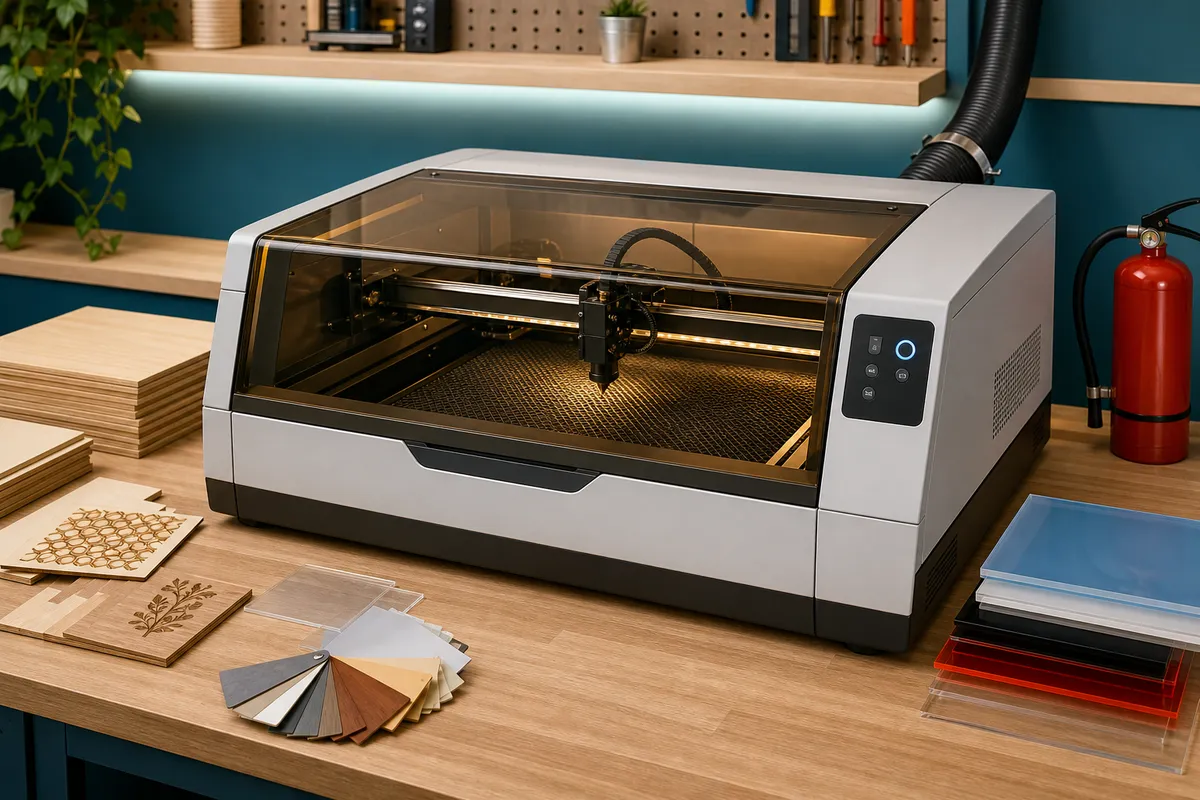
An enclosure changes the machine's whole risk profile: contains stray light, holds smoke for the exhaust to capture, muffles noise, and keeps a permanent ventilation path attached instead of a per-session improvisation.
Check: internal size vs your machine + rotary, duct outlet diameter, window rating, door access.
See options on Amazon →Inline exhaust fan and ducting
Smoke ruins parts, coats optics, and is genuinely bad air. An inline duct fan, smooth hose, and a window adapter beat a bigger laser module as an upgrade, every time. Full plan in our venting guide.
4 in fan, short smooth duct run, vent outdoors whenever possible.
See options on Amazon →Air assist kit
A focused air stream at the kerf clears smoke, reduces charring, suppresses flare-ups, and is the difference between cutting plywood predictably and brute-forcing it with repeat passes.
See options on Amazon →Honeycomb working bed
Supports stock flat, gives smoke and reflected energy somewhere to go, and protects whatever is underneath. Pairs with hold-down pins for repeatable cuts.
Match bed size to your work area; metal backer plate included is a plus.
See options on Amazon →Fire safety kit
A small extinguisher, fire blanket, and spray bottle next to the machine — plus the only rule that really matters: never leave a running laser alone. Lasers don't start big fires; unattended lasers do.
See options on Amazon →Focus gauge and setup tools
Inconsistent focus is why the same file engraves differently on Tuesday. A gauge (or your machine's spacer, used every time) plus calipers makes focus a measurement instead of a vibe.
See options on Amazon →Hold-downs: magnets, pins, and weights
Warped plywood means wandering focus and failed cuts. Honeycomb pins and low-profile magnets keep stock flat without sitting in the beam path.
See options on Amazon →Test material packs
A variety pack of basswood, plywood, slate, cork, and leatherette teaches your machine's real settings faster than any downloaded chart — and keeps experiments off your good stock.
Avoid mystery plastics entirely — see our laser materials guide for why.
See options on Amazon →Lens cleaning and maintenance supplies
Residue on the lens reads as 'my laser got weak' and tempts people into power upgrades they don't need. Swabs, IPA, and a five-minute monthly habit keep the beam honest.
See options on Amazon →If you only buy three
Glasses, enclosure with exhaust, air assist — safety, smoke, and cut quality, in that order. The common beginner mistake is buying more laser power before fixing airflow, focus, and workholding. A modest 10 W diode with this list outperforms a 40 W module sitting in smoke.
Setting up the exhaust is the step people get wrong most often — our venting guide covers duct runs, window adapters, and what filters can and can't do.
Frequently asked questions
Do I really need laser safety glasses if my laser has an enclosure?
Yes. Enclosure windows have ratings, but you'll open the lid with the habit-memory of a hundred safe sessions exactly once at the wrong time, and reflections find gaps. Rated glasses are $30–$60 of permanent insurance for any moment the beam path and your eyes share a room.
Can I vent a laser into a filter instead of outside?
Activated-carbon filter units work for light engraving duty and situations with no window option, but they're consumable (real replacement costs) and weaker than a short duct to outdoors. If a window exists, vent outside; treat filters as the fallback.
What accessory most improves cut quality specifically?
Air assist, by a wide margin, with honest focus habits second. Together they routinely cut the passes needed for 3 mm plywood in half compared to a bare diode module.