Tool guide
Measuring Tools for Makers: Calipers First, Everything Else Second
Updated July 7, 2026
Every machine on this site is a measurement amplifier: feed it the right numbers and it repeats them forever; feed it 'about three inches' and it repeats that forever too. The measuring bench costs a tenth of any machine it serves, and digital calipers are its keystone — the tool that gets touched more than the machines themselves.
Some links on this page are affiliate links. If you buy through them, The Maker Guide may earn a small commission at no extra cost to you. We only point at product categories we would compare ourselves. Details.
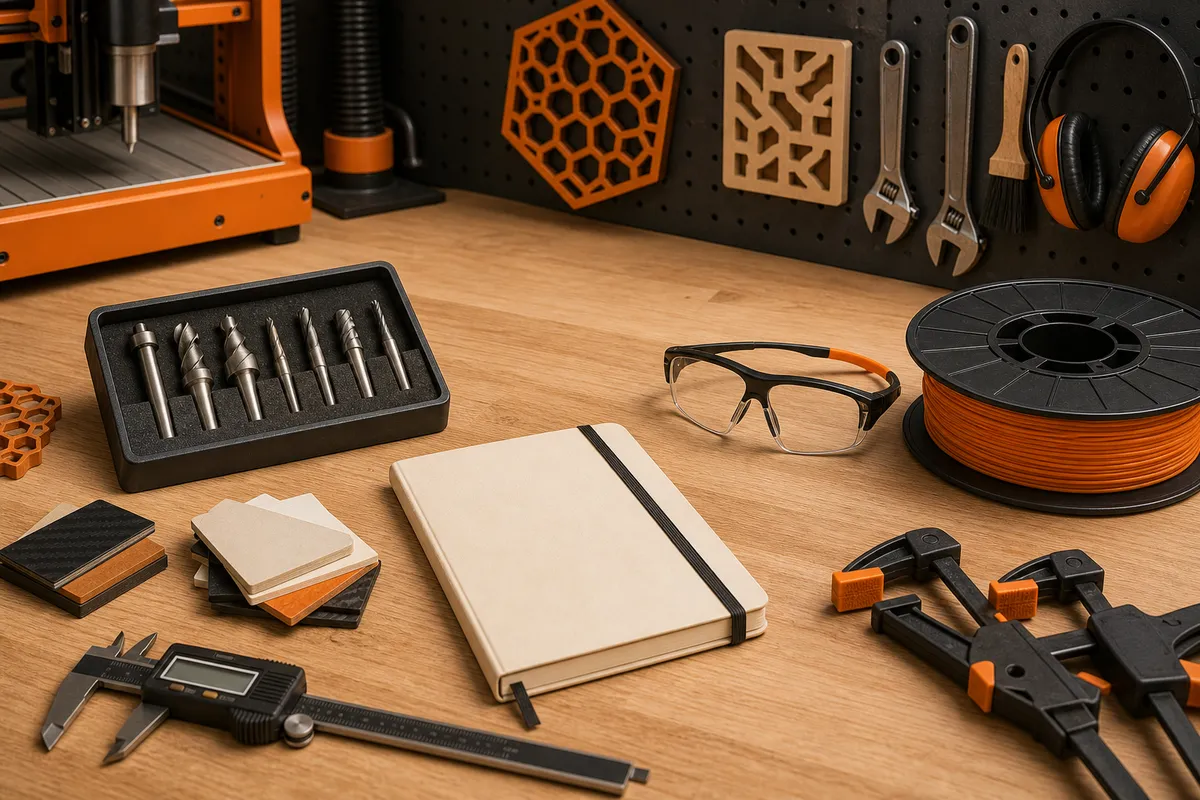
Calipers: the $25 tool you'll use daily
Digital calipers measure four ways — outside, inside, depth, and step — to 0.01 mm resolution, which covers every hobby need: filament diameter, stock thickness before a CNC job, hole sizes for heat-set inserts, the actual (never nominal) size of everything from plywood to bolts. For design work they run backwards too: measuring an existing part to model its replacement is the core loop of functional 3D printing.
The market truth: $20–35 stainless calipers (the better import brands) are accurate to a couple hundredths and genuinely sufficient. Mitutoyo's $150+ instruments buy better feel, battery life, and consistency — worthwhile someday, unnecessary today. What's never worth it: the $10 plastic ones whose jaws flex more than they measure. Habits that keep any pair honest: zero before each session, close gently on the work (calipers measure pressure too), and keep the jaws clean.
Squares, straightedges, and the geometry of trust
Machinist squares (a small precision 90°) check what everything else depends on: CNC fences, spoilboard fixtures, printer frames, and every box you glue. Combination squares add depth/marking versatility — buy one decent one (Irwin/Empire class), not the $8 one whose head wiggles. A steel straightedge (600 mm) finds cupped stock and checks surfaced beds. Speed squares live at the saw. The theme: squares are reference tools — one accurate reference beats five approximate ones, because errors here copy themselves into every project.
The measurement kit (~$100 total)
Digital calipers, 6 in stainless
The keystone. Stainless jaws, real brand (NEIKO/VINCA/iGaging class), spare battery in the case. If one tool on this site gets bought today, it's this.
See options on Amazon →Machinist square set
The 90° reference that trues fences, fixtures, frames, and glue-ups. A small set (2–6 in) covers machine-scale work.
See options on Amazon →Combination square, 12 in
Marking gauge, depth gauge, level, and square in one — the woodworking side's daily driver.
See options on Amazon →Steel rule set + 600 mm straightedge
Rules for layout (150 mm lives at the bench), the straightedge for flatness checks on stock and spoilboards.
See options on Amazon →Marking knife + mechanical pencils + white pencil
A knife line is a 0.1 mm mark a pencil can't make; the white pencil is for walnut and dark materials. Layout accuracy is free accuracy.
See options on Amazon →Feeler gauges + thread checker
The two specialists worth owning early: feelers set probe and nozzle gaps; the thread checker ends the 'is this M4 or #8?' hardware mystery permanently.
See options on Amazon →How accurate do you actually need to be?
| Work | Needed accuracy | The tool |
|---|---|---|
| General woodworking | ±0.5 mm | Tape, rules, squares |
| CNC setup & stock | ±0.1 mm | Calipers, probe |
| 3D printing fits & inserts | ±0.05–0.1 mm | Calipers, test prints |
| Laser kerf compensation | ±0.05 mm | Calipers on test cuts |
| Machinist-envy territory | ±0.01 mm | Micrometers — and honestly, not hobby-required |
Measure the process, not just the parts
The maker-specific trick is measuring your machines' output to calibrate them: a printed 20 mm cube or tolerance coin tells you flow and dimensional accuracy; a lasered 10 mm test square measures your true kerf for press-fit boxes; a CNC-cut circle-diamond-square reveals backlash. Ten minutes of caliper work per machine turns 'it prints a bit big' into a number in a slicer field — after which parts just fit. It's the cheapest upgrade any of the machines will ever get, and it's the same $25 tool every time.
Frequently asked questions
Are cheap digital calipers accurate enough?
The $20–35 stainless tier measures within ±0.02–0.03 mm — beyond what wood, plastic, and hobby metal work require. Their real weaknesses are battery drain on the shelf and dodgy feel in the cheapest units. Skip plastic-jaw models entirely; jaw flex makes them fiction past the first decimal.
Digital, dial, or vernier calipers?
Digital for the instant read, unit switching, and zero-anywhere relative measurements (the killer feature for comparing parts). Dial calipers never need batteries and suit people who hate them. Vernier scales are for the romantics. Functionally, buy digital, keep a cheap dial pair as the backup.
What's the first measuring tool after calipers?
A machinist or good combination square — because squareness errors compound in a way length errors don't. One out-of-square fence signs its name on every part it touches; a reference square catches it in seconds.
Do I need micrometers for 3D printing or CNC?
No — micrometers buy a decimal place (0.001 mm class) that hobby materials can't hold anyway; wood moves more than that with the weather, and prints vary more than that across a single wall. Calipers plus calibration test pieces are the honest precision ceiling for this work.
Why do my parts not fit even though I measured everything?
The usual suspects, in order: the machine adds its own offset (measure a test cut/print and compensate — kerf and flow are real), nominal sizes lied ('3 mm' ply is 2.7, '1/4 in' bolts are 6.35 mm), pressure varied between measurements, or units mixed. The fix is systemic: calibrate the machine once, measure actual stock always, design in one unit.