CNC setup
CNC Dust Collection for Small Routers: A Setup That Actually Works
Updated June 11, 2026
MDF dust is the asbestos-adjacent secret of hobby CNC — fine, abrasive, and everywhere. A working dust setup for a desktop router costs $150–$300 and has four parts: a dust shoe, a vacuum, a separator, and hose routing that doesn't fight the gantry.
Some links on this page are affiliate links. If you buy through them, The Maker Guide may earn a small commission at no extra cost to you. We only point at product categories we would compare ourselves. Details.
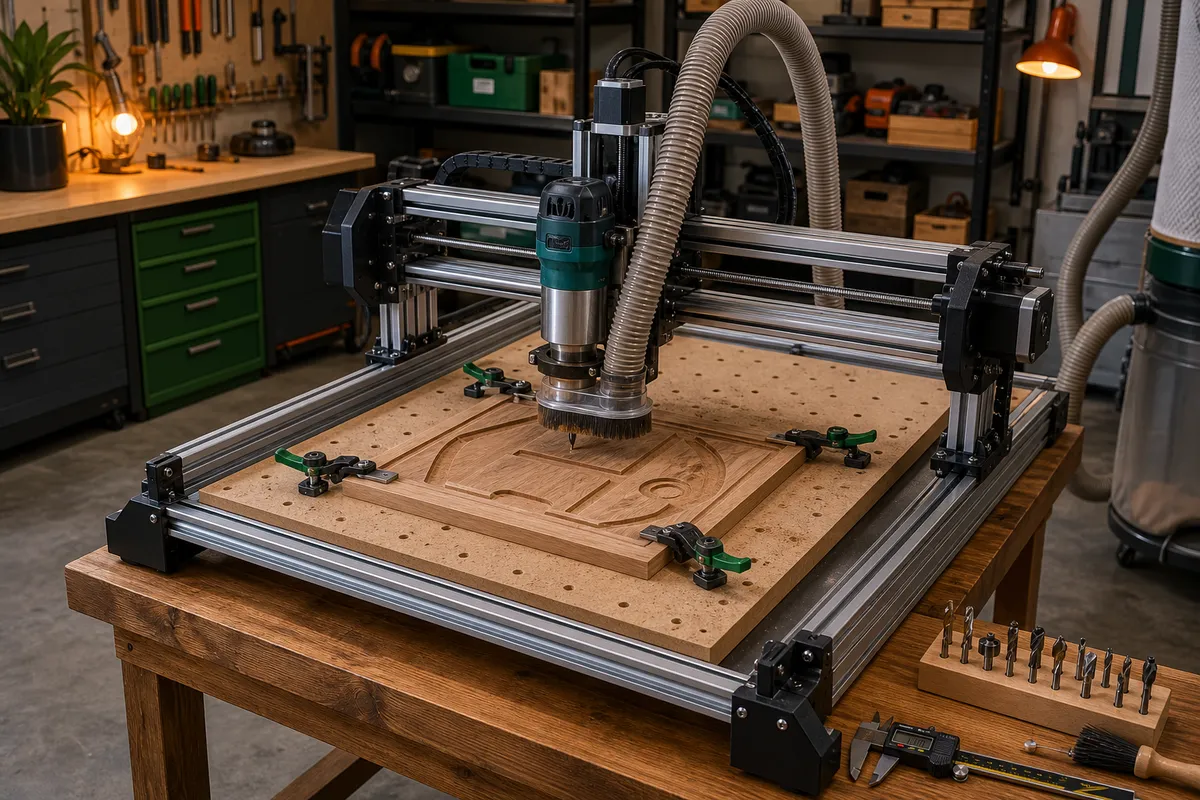
The four-part system
| Part | Job | Typical cost | Skip it and… |
|---|---|---|---|
| Dust shoe (boot) | Captures chips at the bit with a brush skirt | $20–$60 | dust coats rails, wheels, and lungs |
| Shop vacuum | Provides suction; CFM matters more than HP claims | $60–$150 | nothing else works |
| Cyclone separator | Drops 90%+ of chips into a bucket before the vac | $30–$60 | vac filter clogs every job, suction dies |
| Hose routing | Keeps hose weight off the gantry | $10–$30 | lost steps, ruined cuts, mystery offsets |
Dust shoe: match it to your spindle mount
Buy the shoe for your spindle diameter (65 mm is the common hobby size — check before ordering; FoxAlien machines use 52 or 65 mm mounts depending on configuration). Two designs dominate: fixed shoes that bolt to the spindle mount, and independent-Z shoes that ride the material height. For a 4040-class machine, a simple fixed shoe with a removable magnetic brush skirt is the right first buy.
The skirt should touch the material lightly, not drag. If the skirt blocks your view of V-carve work, get a shoe with a clear polycarbonate body or a low-profile brush.
Shop vac vs dust extractor
A standard shop vacuum is the right answer for desktop CNC. Real dust extractors (Festool-class) regulate suction and have HEPA filtration but cost more than the router. What matters in a shop vac: reasonable CFM, a fine-dust filter bag or HEPA cartridge (stock foam filters pass MDF dust straight through), and a hose diameter you can adapt to the shoe — most shoes take 35–40 mm hose.
Noise is the underrated spec. A CNC job runs for an hour; a 78 dB vac is the difference between checking on the job and avoiding the garage. Quieter vacs (Fein-style, or vacs marketed near 60-ish dB) are worth real money for CNC duty, and a vac muffler helps the rest.
The separator is not optional
A $35 cyclone between shoe and vac drops the chips into a 5-gallon bucket and sends mostly-clean air to the vac. Without one, MDF dust packs the vac filter in a job or two, suction falls off a cliff mid-cut, and the shoe stops capturing. With one, you empty a bucket occasionally and the filter lasts months. It is the best value item in the whole system.
Hose routing and the lost-step bug
If your machine suddenly cuts offset patterns with no error, check the hose before reflashing anything. A hose that snags or whose weight loads the gantry causes missed steps on open-loop steppers. Route the hose overhead from a ceiling hook or a mast clipped to the machine frame, leave a service loop, and make sure full X/Y travel doesn't tension it. (Closed-loop machines like the FoxAlien Masuter 3S will fault or correct instead of silently drifting — one more reason that spec matters.)
A known-good shopping list
65 mm CNC dust shoe with brush skirt
Fits the common hobby spindle mounts; magnetic or thumb-screw skirts make bit changes painless. Verify your spindle diameter first.
See options on Amazon →Cyclone dust separator kit
Bucket-lid cyclones turn any shop vac into a two-stage system. Get one with anti-static hose if you cut a lot of MDF.
See options on Amazon →Quiet shop vacuum with HEPA-class filtration
CNC duty means hour-long runtimes — prioritize noise level and fine-dust filtration over peak horsepower marketing.
See options on Amazon →Respirator for MDF days
Even good collection misses some fines, and surfacing your spoilboard makes clouds. A P100 half-mask is cheap and comfortable enough to actually wear.
See options on Amazon →What about an enclosure?
An enclosure helps with noise and contains the dust the shoe misses, but it is a project, not a purchase — sized to your machine plus hose mast plus Z clearance. Build it after the four-part system works, not instead of it. If you want to see a well-sorted CNC dust setup running before you copy it, the machines at The Makr Lab are set up exactly this way.
Frequently asked questions
Can I run a desktop CNC without dust collection?
Mechanically yes, briefly. Practically: MDF and hardwood fines coat the rails and wheels, get into electronics, ruin visibility for tool changes, and are genuinely bad to breathe. A shoe plus shop vac is the minimum responsible setup, even for occasional use.
Why does my shop vac lose suction during long CNC jobs?
The filter is loading with fine dust. Add a cyclone separator — it removes the bulk before the vac — and switch the vac to a fine-dust bag or HEPA cartridge. Stock foam filters are for water and wood chips, not MDF flour.
Does a dust shoe affect cut quality?
Positively: clearing chips from the cut reduces re-cutting and heat, which keeps bits sharp and edges clean. The only downside is visibility, solved by clear-body shoes or removable skirts.