Top 10 · June 2026
Top 10 CNC Router Accessories for Beginners (June 2026)
Updated June 11, 2026
Ranked by impact per dollar for a new 4040-class CNC owner, as of June 2026. The pattern across the whole list: accessories that prevent failures beat accessories that add capability. Numbers one through five fix the ways beginner jobs actually die.
Some links on this page are affiliate links. If you buy through them, The Maker Guide may earn a small commission at no extra cost to you. We only point at product categories we would compare ourselves. Details.
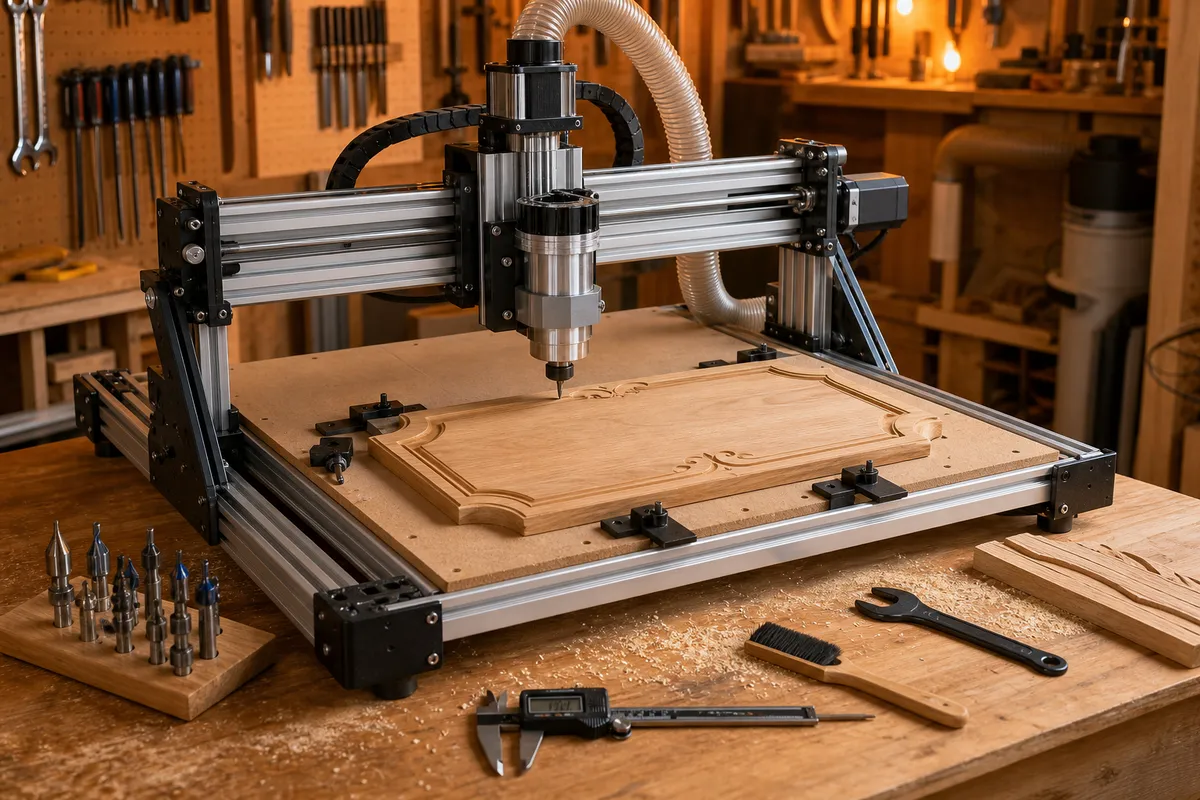
The list
Workholding kit (cam clamps + tape and CA glue)
Moving stock is beginner failure #1, and twenty dollars of clamps fixes it. Add painter's tape and CA glue for through-cuts and you've covered every workholding situation your first year will produce.
Compare clamp kits →Real bit assortment (1/8 in up/down + V-bits)
Stock bits are placeholders. An assortment with upcut, downcut, and 60°/90° V-bits unlocks signs, trays, and clean plywood — the actual beginner project list.
See options on Amazon →Dust shoe + cyclone separator
Failure #2 is the slow kind: MDF dust in rails, lungs, and the vac filter. A $40 shoe and a $35 cyclone make hour-long jobs sustainable. Full setup in our dust collection guide.
See options on Amazon →Digital calipers
Stock is never the thickness the label claims, and CAM needs the truth. A $25 caliper pays for itself the first time a through-cut doesn't gouge your spoilboard.
See options on Amazon →Z-probe / touch plate
Manual paper-zeroing works until it doesn't. A touch plate makes Z-zero repeatable to a few hundredths of a millimeter and eliminates the most common cause of cuts that are mysteriously 0.5 mm too deep.
See options on Amazon →Spoilboard surfacing bit (1 in)
Your machine is only as flat as its spoilboard. Surface it once at setup and your engraving depths suddenly become consistent across the whole bed.
See options on Amazon →Threaded inserts + bolt assortment
Turns the spoilboard into a fixture plate: clamps anywhere, fences that bolt down square, jigs that return to position. The best sub-$30 machine upgrade there is.
See options on Amazon →Hearing protection and P100 respirator
A trim router plus shop vac runs 95+ dB for an hour at a time, and surfacing MDF makes dust clouds collection can't fully catch. Boring, cheap, non-negotiable.
See options on Amazon →Collet wrench set + torque habits
Bits slip from under-tightened collets and break from over-tightened ones. Proper wrenches (and replacing the collet itself yearly) prevents both flavors of scrap.
See options on Amazon →Offline controller or dedicated cheap tablet
Freeing your laptop from hour-long sender duty is a quality-of-life upgrade you feel every session. Many FoxAlien and Genmitsu machines include one — check before buying.
See FoxAlien accessories →What didn't make the list
A laser module — genuinely useful, but it's a capability, not a foundation; add it when a project demands it. A 4th axis — wait until you've sold your tenth tumbler design. A VFD spindle — a production upgrade for a machine you're still learning. The first $250 should make the machine you own reliable, not make it different.
If you're still deciding which machine these accessories would bolt onto, start with our beginner CNC router guide.
Frequently asked questions
What should I buy with a new CNC router on day one?
Clamps, a real bit set, and calipers — about $80 total. Add the dust shoe and separator before your first MDF job, and a touch plate the first time you scrap a part to a bad Z-zero (so: soon).
Are cheap Amazon CNC bits okay for beginners?
Yes — a $30 assortment is the right way to learn which geometries you actually use, and beginner feeds dull bits faster than quality differences matter. Upgrade the two or three bits you reach for constantly to Whiteside/Amana/SpeTool grade once your settings stabilize.
Do I need a touch plate if I'm careful with paper zeroing?
Careful paper zeroing gets within ~0.1 mm when nothing distracts you. The touch plate isn't about precision on a good day — it's about removing the bad day where you zero on top of a chip and carve 1 mm into your spoilboard through a finished part.