CNC comparison
CNC Router vs Laser Cutter: Which First Machine Fits Your Projects?
Updated June 11, 2026
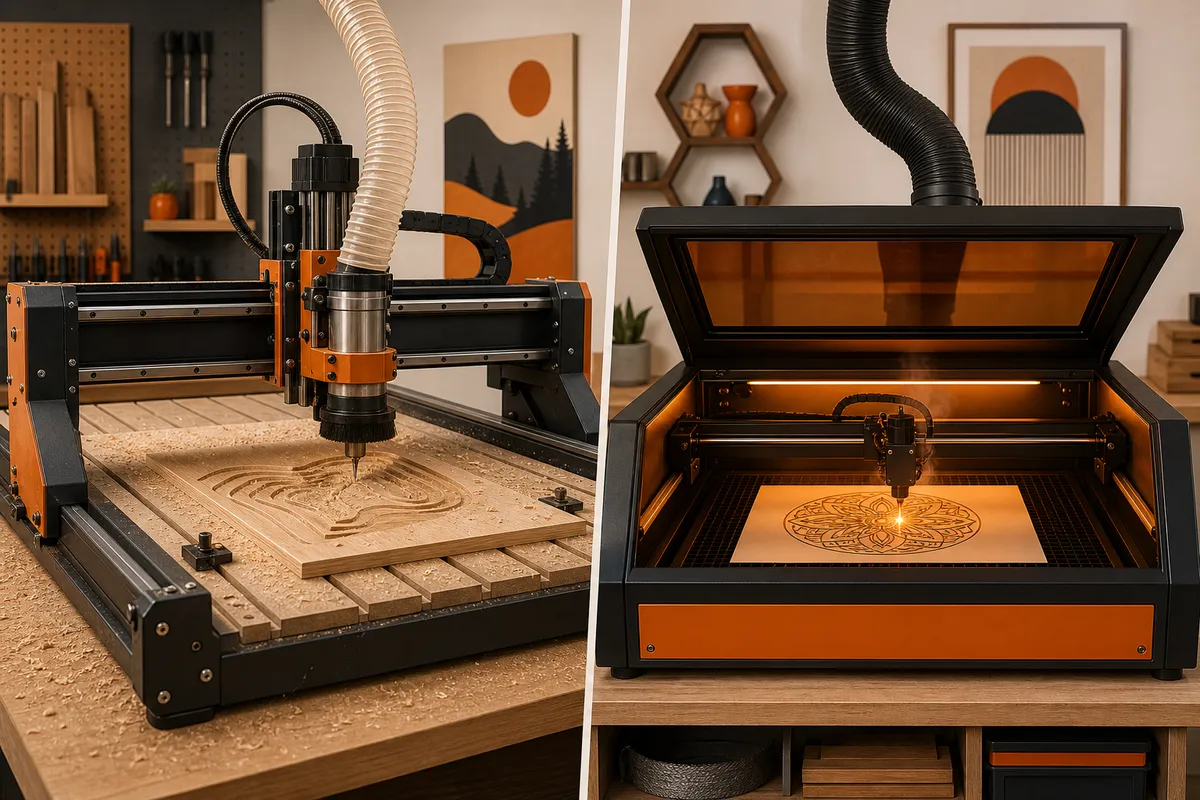
Both machines cut shapes from flat stock, which is where the similarity ends. A CNC router is a 3D sculpting tool that's loud and messy; a laser is a 2D precision tool that makes smoke. The decision comes down to one question: do your projects have depth?
Some links on this page are affiliate links. If you buy through them, The Maker Guide may earn a small commission at no extra cost to you. We only point at product categories we would compare ourselves. Details.
The one-question test
Look at your last ten project ideas. If they involve carved depth — juice grooves, pockets, rounded edges, relief carving, joinery, thick hardwood — that's CNC territory. If they are flat shapes with fine detail — ornaments, earrings, box art, engraved photos, layered signs from 3 mm stock — that's laser territory.
If the list splits evenly: lasers have the gentler learning curve, smaller footprint, and lower entry price, which makes them the better first machine for most undecided buyers — with ventilation as the non-negotiable catch.
Honest side-by-side
| CNC router (4040-class) | Diode laser (10–20 W class) | |
|---|---|---|
| Entry price that's actually usable | $500–$900 (e.g., FoxAlien Masuter 3S) | $300–$700 plus enclosure/exhaust |
| Cuts | Wood to 40 mm+, plastics, soft metals | Plywood/basswood to ~6–10 mm, acrylic only if CO2 or careful with cast |
| Third dimension | Real: pockets, V-carves, relief, joinery | None — engraving depth only |
| Detail floor | Limited by bit diameter (~1 mm practical) | ~0.1 mm beam: photo engraving, tiny text |
| Mess | Chips and fine dust — needs collection | Smoke and residue — needs exhaust outdoors |
| Noise | Router scream + vacuum (hearing protection) | Quiet pump hum; fan noise |
| Workholding | Real skill to learn | Mostly gravity, magnets, and pins |
| Beginner failure mode | Stock moves, bits snap | Char, fire risk, bad materials |
Money math beginners skip
The CNC's sticker price is closer to its real price — add bits, clamps, and dust collection and a $600 machine is an $800 system. The laser's sticker price is further from real: by the time a diode laser is set up responsibly — enclosure, exhaust, air assist, safety glasses — a $400 machine is a $700–$800 system too. The honest gap between the two paths is smaller than the listings suggest.
Material costs flip the other way: laser stock (3 mm plywood, basswood) is cheap and ships flat; CNC-grade hardwood costs real money and needs a way to get it flat.
What about machines that do both?
CNC platforms with laser modules (FoxAlien sells these as bundles) are genuinely useful — engraved detail on carved parts in one fixture is a combination dedicated machines can't match. But a module on an open CNC frame is harder to vent and enclose than a dedicated laser, so treat hybrids as a CNC with a bonus, not as two machines for one price. Our FoxAlien project guide covers what the combo does well.
The try-before-buying answer exists too: makerspaces like The Makr Lab in Anaheim have both machine types on the floor — an afternoon with each will settle the question better than any table on the internet.
Frequently asked questions
Which is easier for a complete beginner?
The laser. Software is simpler (2D images in LightBurn vs CAM toolpaths), workholding barely exists, and first results come in minutes. The trade is that laser safety — ventilation, fire watch, material knowledge — is less forgiving than CNC safety, and has to be taken seriously from day one.
Which makes more money for a side business?
Lasers usually win on personalization speed (tumblers, ornaments, engraved gifts) with thin margins and fast turnaround; CNC wins on higher-ticket items (cutting boards, signs, furniture-adjacent pieces). Markets reward both — see our laser project and CNC business guides for specifics.
Can a laser cut what a CNC cuts?
No. A 10–20 W diode laser realistically cuts to about 6–10 mm in soft plywood with multiple passes, can't touch hardwood thickness, and never produces pockets or 3D surfaces. A CO2 laser cuts thicker acrylic and plywood but still lives in flatland.