CNC buying guide
Best Beginner CNC Routers: How to Actually Choose One
Updated June 11, 2026
There is no single best beginner CNC router — there is a best router for your projects, space, and tolerance for tinkering. This guide gives you a working framework and a current shortlist by budget tier, as of June 2026.
Some links on this page are affiliate links. If you buy through them, The Maker Guide may earn a small commission at no extra cost to you. We only point at product categories we would compare ourselves. Details.
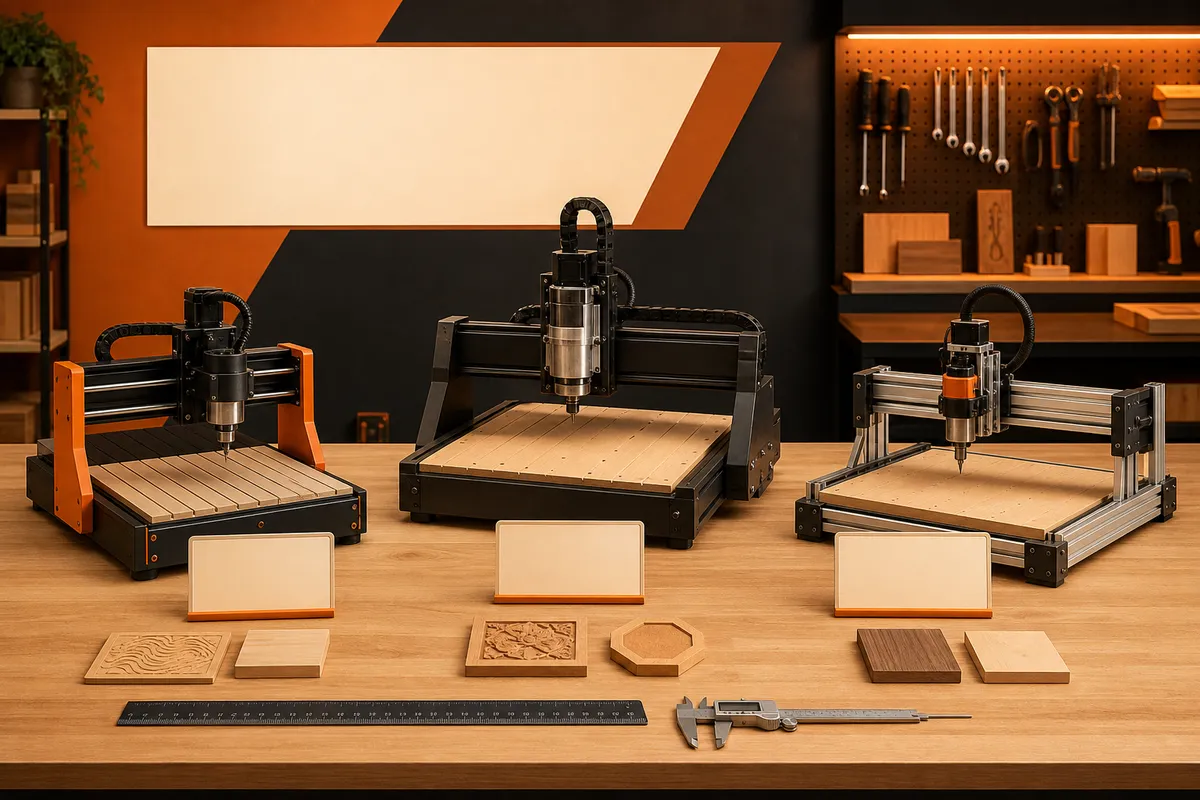
The three questions that pick the machine
What will you cut? Soft woods, plywood, and MDF are fine on almost anything. Hardwoods want rigidity. Aluminum is possible on hobby machines but only on the stiffer ones, with shallow passes and patience.
How big are your real projects? Be honest. Coasters, signs, trays, and templates fit a 400 × 400 mm bed. If your dream project is a dining-table top, no benchtop machine fixes that — you would tile the cut or have a shop like OCreate run it on a full-size machine.
How much tinkering do you enjoy? Cheap kits are partly a kit hobby: you will square, shim, tram, and upgrade. Mid-tier machines mostly cut. Premium benchtops mostly just work.
Beginner CNC tiers as of June 2026
| Tier | Typical price | What you get | Honest fit |
|---|---|---|---|
| 3018-class kits | $200–$400 | Small bed (~300 × 180 mm), low-power spindle, lots of plastic in the motion system | Engraving, soft materials, learning G-code cheaply. Outgrown fast. |
| 4040-class hobby machines (FoxAlien Masuter 3S, Genmitsu 4040-PRO) | $500–$900 | 400 × 400 mm beds, real frames, optional laser/rotary add-ons | The sweet spot for most first buyers making signs, gifts, and small parts. |
| Benchtop prosumer (Shapeoko 5 Pro, Onefinity) | $1,700–$3,500+ | Serious rigidity, bigger work areas, better electronics and support | Buyers who already know they will use it weekly, or want light production. |
Specs that matter (and specs that don't)
- Rigidity beats work area. A stiff 400 mm machine makes better parts than a flexy 750 mm one. Look for aluminum extrusion or steel frames, large leadscrews or ball screws, and supported rails.
- Z clearance gets ignored, then regretted. Clamps, spoilboard, and bit length all eat into it. The FoxAlien Masuter 3S lists 95 mm of Z travel, which is generous for this class.
- Closed-loop steppers (on the Masuter 3S, for example) can catch missed steps before they ruin a job — a real quality-of-life feature on long cuts.
- Spindle wattage numbers are marketing-adjacent. A 400 W+ spindle or a trim-router mount matters more than the number printed on a 60 W 'spindle' in a 3018 listing.
- Software ecosystem matters more than specs. GRBL-based machines work with Candle, UGS, and Carbide-style senders, and every tutorial on the internet.
Current shortlist by tier
Starting points to compare, chosen for rigidity per dollar and community support — confirm current bundles and prices before buying.
FoxAlien Masuter 3S (4040-class)
400 × 400 × 95 mm working area, closed-loop NEMA23 steppers, and a deep upgrade catalog — laser module, rotary, extension kit, VFD spindle — so the machine grows with you instead of getting replaced.
See the Masuter 3S at FoxAlien →Genmitsu 4040-PRO (4040-class alternative)
SainSmart's semi-assembled design with locating pins makes it the easiest path to a square machine on day one, and the Genmitsu accessory ecosystem is huge.
See options on Amazon →3018-class starter kit (budget tier)
If the budget is hard-capped under $300, a 3018 teaches CAM, feeds and speeds, and workholding for the price of a single Shapeoko accessory. Just know you are buying a class, not a keeper.
See options on Amazon →CNC starter bit set + ANSI safety glasses
Whatever machine you pick, budget $50–$80 for a 1/8 in bit assortment and real eye protection. The included bits in most kits are test cuts waiting to fail.
Compare bit sets on Amazon →Budget for the whole system, not the sticker
Plan on 15–30% over the machine price for the first month: bits ($40–$80), clamps and workholding ($30–$60), a dust shoe and shop vac hose adapters ($30–$50), spoilboard material, and test stock. A $600 machine is realistically a $750–$800 project.
What you should not buy yet: a VFD spindle upgrade, a fourth axis, or exotic bits. Upgrade when a real project blocks on the limitation — see our accessory priority list.
Frequently asked questions
Is a 3018 CNC good enough to start with?
It is good enough to learn on — CAM software, feeds and speeds, workholding, and G-code all transfer to bigger machines. It is not good enough to stay on if you want clean cuts in hardwood or anything resembling production. Most owners outgrow one within six months.
Can beginner CNC routers cut aluminum?
4040-class machines can, with single-flute bits, shallow passes (0.1–0.2 mm), lubricant, and realistic expectations. It is slow and loud. If aluminum parts are the main goal, save for a rigid benchtop machine or have parts made while you learn.
What's the real difference between a $600 and a $2,000 machine?
Rigidity, motion components, and support. The $2,000 machine cuts faster with cleaner edges, holds tolerance across the bed, and has a company behind it. The $600 machine makes the same coaster — it just asks more of you along the way.
Do I need a computer dedicated to the CNC?
No. Any laptop that runs a G-code sender works, and many hobby machines (including FoxAlien and Genmitsu models) ship with offline controllers so you can run jobs without a computer attached.