Tools & decisions
Buy vs Borrow: When Maker Tools Deserve Your Garage
Updated June 11, 2026
Every tool you own charges rent: money, space, maintenance, and the guilt of disuse. Borrowing — makerspaces, tool libraries, friends' garages — converts that to a per-use cost. Four questions sort which side of the line any tool belongs on.
Some links on this page are affiliate links. If you buy through them, The Maker Guide may earn a small commission at no extra cost to you. We only point at product categories we would compare ourselves. Details.
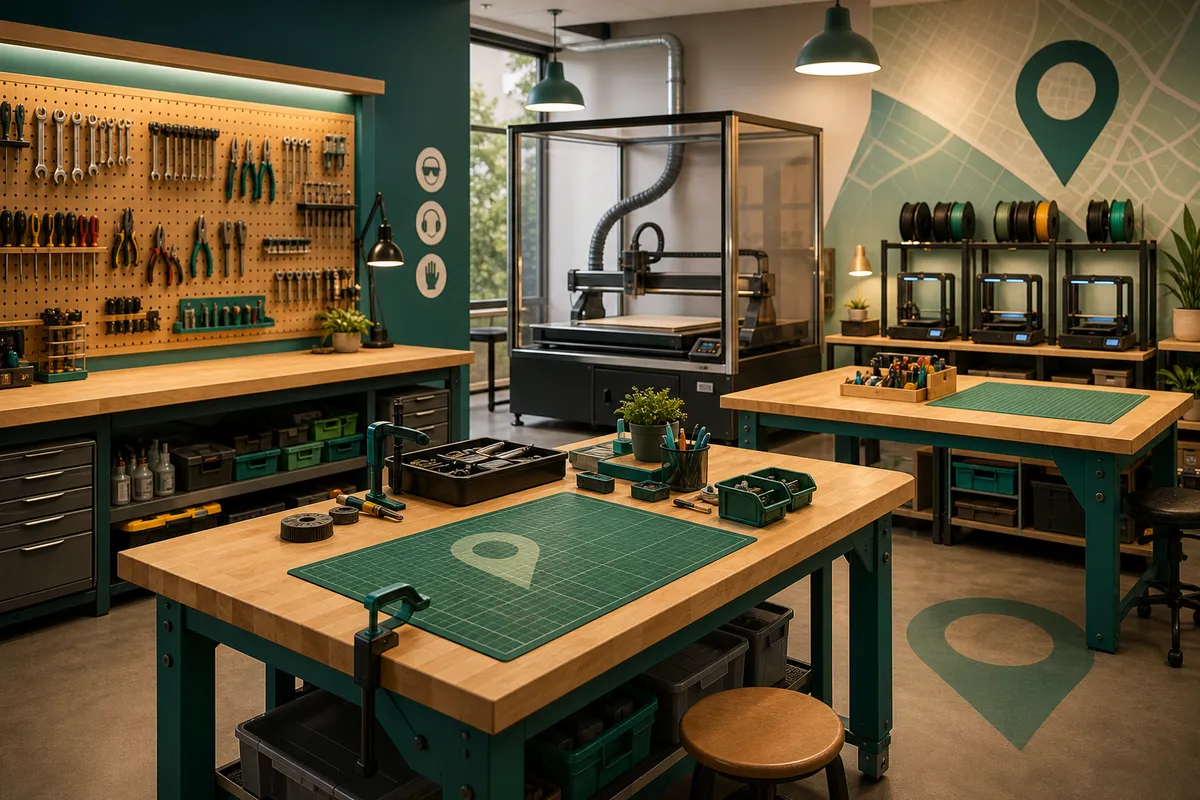
The four questions
- Frequency: Will you use it more than monthly? Weekly use buys tools; quarterly use borrows them.
- Spontaneity: Does the work happen in 20-minute bursts (3D printer queued at lunch) or planned sessions (a Saturday of CNC)? Burst tools want to live at home; session tools share beautifully.
- Transport: Does the work move? A sander comes to the project; a 60 W CO2 laser doesn't. Untransportable work argues for access over ownership only if the material moves easily instead.
- Skill curve: Are you still learning what good looks like? Shared machines come with people — the feedback loop that turns six months of solo YouTube into three weekends.
The usage math
Ownership cost = (price + accessories + consumables) ÷ honest uses per year, plus the space it occupies. A $700 equipped laser used 40 times a year costs ~$18/session and earns its bench. The same laser used for one December gift run costs $350/session — a makerspace day pass embarrasses that number.
The trap is aspirational frequency: buying for the maker you plan to become. The honest fix: borrow first, count actual sessions for two months, then buy at the rate you measured. Machines bought after borrowing get used; machines bought from enthusiasm get dusted.
What to buy vs share, by category
| Almost always buy | Usually share/borrow | Depends |
|---|---|---|
| Safety gear (never share PPE fit) | CO2 lasers, big-format CNC | Diode lasers (cheap enough to buy, smoky enough to share) |
| Calipers, squares, hand tools | Welders, plasma, metal mills | 3D printers (burst-use says buy; quality printers at spaces say try first) |
| Clamps and workholding | Wide planers, jointers, drum sanders | 4040 CNCs (the whole buy-decision guide) |
| Consumables (bits, filament, glue) | Anything used once for one project | Sewing/embroidery machines |
Makerspace economics, honestly
A membership at a community makerspace typically runs $50–150/month and buys access to more machine capital than a $30,000 garage build — plus training, ventilation infrastructure someone else maintains, and the non-trivial asset of people who'll look at your failed cut and say 'feed rate.' Spaces like The Makr Lab in Anaheim run exactly this model: 3D printing, lasers, CNC, and electronics benches with help nearby.
The membership also solves the sequencing problem from our budget guide: use the space's machines while tier-1 money goes to the bench and hand tools that have no shared substitute. And for the occasional job beyond any hobby machine — a one-off in 1/2 in aluminum, a batch of 200 — OCreate's fabrication services are the borrow-side answer at production scale.
Frequently asked questions
Is a makerspace membership worth it if I already own tools?
Often yes, for the machines you don't own — the CO2 laser and big CNC tier — and for the community feedback loop. Many owners keep burst-use tools (printer, hand tools) at home and use the space as their heavy-machine annex.
What tools should you never borrow?
PPE that has to fit (respirators, glasses), precision instruments you'll calibrate trust into (your calipers), and anything you use weekly — at that frequency, scheduling friction costs more than ownership. Also: don't borrow what you can't afford to replace; lending relationships are worth more than tools.
How do I find tool access near me?
Search 'makerspace' or 'hackerspace' plus your city, check library systems (many now lend tools and house printers), and look for community college shop programs. In Orange County, The Makr Lab is the one we know best — sites like Places for Makers maintain wider directories.