Materials
Plywood for Laser and CNC: Why Baltic Birch Wins and Big-Box Ply Fights You
Updated July 7, 2026
Plywood is the default sheet good for both lasers and CNCs, and the quality spread is enormous: the same 'plywood' label covers void-free Baltic birch that cuts like a dream and construction ply whose hidden voids, patches, and mystery glue ruin one project in three. Material choice is a machine setting.
Some links on this page are affiliate links. If you buy through them, The Maker Guide may earn a small commission at no extra cost to you. We only point at product categories we would compare ourselves. Details.
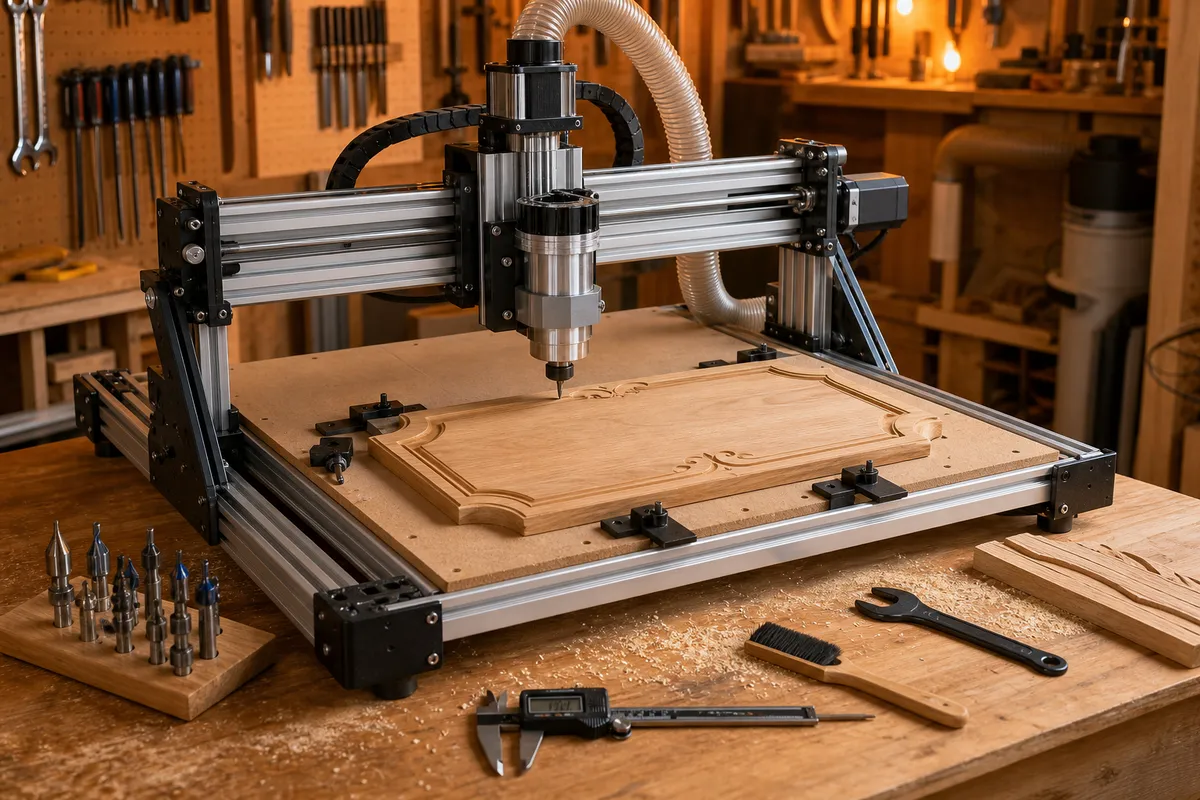
The plywood hierarchy for machine work
| Material | Laser | CNC | Cost (3 mm, per ft²) | The story |
|---|---|---|---|---|
| Baltic birch | The standard — consistent, clean edges | The standard — void-free, crisp details | $2–4 | Many thin, uniform birch plies; no voids to surprise you |
| 'Craft plywood' (basswood/poplar core) | Excellent — cuts at lower power | Good for light duty | $2–5 | Sold in laser-sized sheets; check for interior filler |
| Hardwood-veneer ply (oak/walnut face) | Good; veneer looks premium engraved | Good — downcut bit mandatory for the face | $3–6 | Pretty face, ordinary core; edges show the sandwich |
| MDF | Cuts fine; edges char dark; heavy fumes | Machines beautifully; brutal dust | $0.50–1 | The cheap, flat, boring workhorse for jigs and paint-grade |
| Big-box sanded ply | Gamble — voids and glue vary sheet to sheet | Gamble — voids appear mid-pocket | $1–2 | Built for subfloors, not for 0.1 mm tolerances |
Why Baltic birch became 'laser plywood'
Real Baltic birch is all-birch, in many thin plies (a 12 mm sheet has 9 plies where big-box ply has 5), with no interior voids and typically exterior-grade glue. For lasers that means the beam meets consistent material all the way through — no hidden knot that suddenly doesn't cut, no air pocket that flares. For CNCs it means pockets and edges come out uniform, and screw-together joints hold because every ply is real wood.
Buy it as 5 × 5 ft sheets from hardwood dealers (cheapest per square foot, bring a saw), or as pre-cut 12 × 12 in and 12 × 20 in sheets sized for laser beds — the per-sheet premium buys flatness, which matters more than price the day a warped sheet lifts out of focus.
The glue detail nobody checks
Plywood is wood plus adhesive, and the adhesive decides the laser experience. Interior-grade urea-formaldehyde cuts easily; exterior/marine phenolic glue (and 'waterproof' craft plys) resists the beam — same wood, same thickness, 30–50% more power needed, with browner edges. MDF's high resin fraction is also why it chars darker and smells worse than solid wood. None of these are dangerous the way PVC is a hard never — but they're why 'my 5 mm settings stopped working on the new batch' is usually a materials story, not a machine story.
The practical rule: buy machine plywood from sellers who name the species and glue, and re-test settings per batch, not per lifetime.
The sheet-goods shopping list
Baltic birch 3 mm, laser-sized sheets
The default stock for ornaments, earrings, signs, and boxes. Buy the 20–30 sheet packs; single sheets are the expensive way to buy the same thing.
See options on Amazon →Baltic birch 6 mm
The structural size: boxes that hold weight, signs that don't flex, CNC trays and organizers. A 10 W diode crosses it in 2–3 passes; CNCs don't care.
See options on Amazon →MDF 6 mm / 1/4 in
For jigs, spoilboards, paint-grade signs, and settings tests. Cheap enough to waste, flat enough to trust.
See options on Amazon →Walnut/oak veneer plywood sheets
The premium look for engraved gifts at plywood prices — the veneer engraves with hardwood contrast while the core keeps cost down.
See options on Amazon →Wide masking/transfer tape
Mask the show face before lasering and smoke staining wipes away with the tape — the difference between 'sand every piece' and 'peel and ship.'
See options on Amazon →Matching thickness to machine
For diode lasers: 3 mm is the everyday size (one or two passes on 10 W machines), 5–6 mm is the ambitious ceiling. For CO2: 6 mm routine, 12 mm possible. For CNC: thickness is just passes — but ply under 6 mm wants tape-and-glue workholding since clamps distort it, and a compression bit earns its price the first time both faces of a batch come out clean. Cross-machine makers note: the same 3 mm birch stock feeds both machines, which simplifies inventory more than any other material choice.
Frequently asked questions
What plywood is safe to laser cut?
Interior-grade woods with standard adhesives — Baltic birch, basswood/poplar craft ply, and veneer-core hardwood ply are all routine. The material to refuse: anything PVC-faced or 'vinyl laminated' (chlorine gas), and unknown glossy laminates generally. When a sheet is a mystery, a corner test-burn outdoors plus a sniff for acrid chlorine is the old-timer screen.
Why won't my usual settings cut through the new batch of plywood?
In likelihood order: different glue (exterior/phenolic needs 30%+ more power), higher moisture (new delivery, humid storage), a denser core species, or a dirty lens taking the blame. Recalibrate with a test grid per batch — it costs one offcut and ten minutes.
Is MDF bad for lasers or CNCs?
Neither — it machines and cuts predictably and it's the cheapest flat stock there is. The costs are cosmetic and environmental: dark charred laser edges, legendary amounts of fine CNC dust (run real dust collection), heavier laser fumes, and zero water tolerance. For painted work and jigs it's the right answer.
Baltic birch prices jumped — are there substitutes?
Supply has been erratic since 2022 (much of it originated from Russia and the Baltics). 'ApplePly'-style domestic multi-ply, poplar-core craft ply, and premium birch from new sources fill the gap; judge candidates by ply count, void-free edges, and named glue rather than the phrase 'Baltic.' For paint-grade projects, MDF sidesteps the whole issue.
Can I use 3 mm plywood for CNC projects?
Yes — it's a favorite for layered/stacked designs, boxes, and ornaments. The technique that matters is workholding: painter's tape + CA glue over the full back face, a fresh surfaced spoilboard beneath, and a downcut or compression bit to keep the thin faces clean.