CNC projects
Beginner CNC Projects That Teach Skills (and Can Sell)
Updated June 11, 2026
Good first projects do two jobs: each one teaches a specific skill, and each one is something a person might actually want. These eight are ordered so every project builds on the last — and the selling notes are honest about what moves at a craft fair versus what just looks good on Reddit.
Some links on this page are affiliate links. If you buy through them, The Maker Guide may earn a small commission at no extra cost to you. We only point at product categories we would compare ourselves. Details.
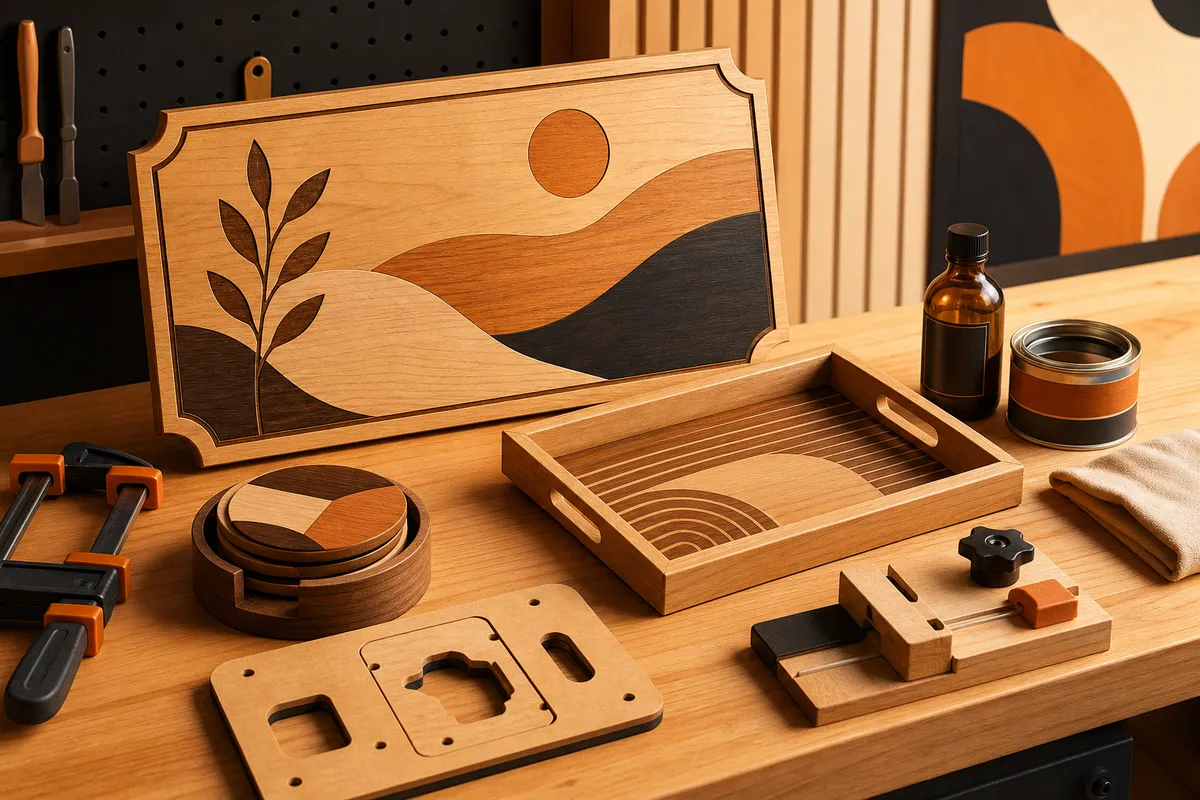
The progression
| # | Project | Skill it teaches | Sells? |
|---|---|---|---|
| 1 | Coaster set with profile + engraving | Workholding, zeroing, two toolpaths in one job | Yes — in sets of 4 with a holder |
| 2 | V-carved name sign | V-carve toolpaths, fonts, depth control | Yes — personalization is the product |
| 3 | Spoilboard with threaded inserts | Surfacing, drilling grids, machine accuracy | No — but it upgrades every later project |
| 4 | Catch-all tray with pocketing | Deep pocketing, finishing, roundovers | Yes — steady seller |
| 5 | Phone stand / business card holder | Joinery-free 3D parts from 2D toolpaths | Modest — good for markets |
| 6 | Shop templates and jigs | Precision, repeatability, design thinking | No — they make project 8 possible |
| 7 | Cribbage board or game board | Hole grids, multi-tool jobs, patience | Yes — premium price in hardwood |
| 8 | Juice-groove cutting board | Surfacing glue-ups, deep grooves, oil finish | Yes — the classic CNC product |
1–2: The first weekend
Coasters are the perfect first cut: small stock, cheap mistakes, and one job teaches profile cuts plus engraving. Use the tape-and-CA workholding trick so through-cuts don't launch parts. The V-carved sign comes next because lettering is where CNC stops feeling like a printer and starts feeling like magic — and personalized signs are the single most requested CNC item, period.
Material note: start in poplar or alder, not pine (knots deflect small bits) and not oak (save hardwood money until your feeds are dialed — see best woods for CNC).
3–6: The shop pays itself
The threaded-insert spoilboard and the jig library are the unsexy middle that separates people who finish projects from people who restart them. Every fixture you make collapses setup time on everything after it.
Trays and phone stands are where you learn finishing: roundover passes, sanding sequence, and oil or wipe-on poly. Finishing quality is most of the difference between 'made with a CNC' and 'looks store-bought.'
7–8: The products
Cribbage boards command surprising prices in walnut or maple — the hole grid is tedious by hand and trivial by CNC, which is exactly the kind of arbitrage a machine should do. Cutting boards with juice grooves are the standard CNC product for a reason: high perceived value, repeatable, and consumable (people buy more than one).
If a design starts selling faster than one machine can make it, that's a good problem — batch with jigs, or hand a production run to OCreate while you keep designing. And if you want feedback before market day, maker communities like The Makr Lab are full of people who will tell you the truth about your finish quality.
Project supplies worth having on hand
Hardwood blanks variety pack
Pre-surfaced small blanks in walnut/maple/cherry skip the milling you can't do yet and make first projects look premium.
See options on Amazon →Food-safe board oil + beeswax finish
For cutting boards and trays — a finish that's safe, easy to apply, and easy for customers to renew.
See options on Amazon →Sandpaper assortment 120–320
Every project above ends with sanding. Buy more than feels reasonable.
See options on Amazon →Frequently asked questions
What's the best first CNC project?
A set of four coasters with an engraved design: one job teaches zeroing, workholding, profile cuts, and engraving, the stock costs almost nothing, and you end up with a finished object the same afternoon.
What CNC projects actually sell?
Personalized items (name signs, established-date signs), cutting boards, cribbage boards, and tray/organizer items sell consistently. Generic decor sells poorly. The pattern: personalization or utility sells, 'look what my machine did' doesn't — buyers don't care how it was made.
How much should I charge for CNC work?
Material × 3 plus an hourly rate for design time is a common floor for craft-market work. Underpricing is the classic mistake — machine time, finishing, and the failed-parts rate are real costs. See our small CNC business guide for the longer math.