Laser comparison
Diode vs CO2 Laser Cutters for Garage Makers
Updated June 11, 2026
The diode vs CO2 question has a clean fault line: clear acrylic and speed live on the CO2 side; price, footprint, and zero-maintenance optics live on the diode side. Decide which side your projects live on and the machine picks itself.
Some links on this page are affiliate links. If you buy through them, The Maker Guide may earn a small commission at no extra cost to you. We only point at product categories we would compare ourselves. Details.
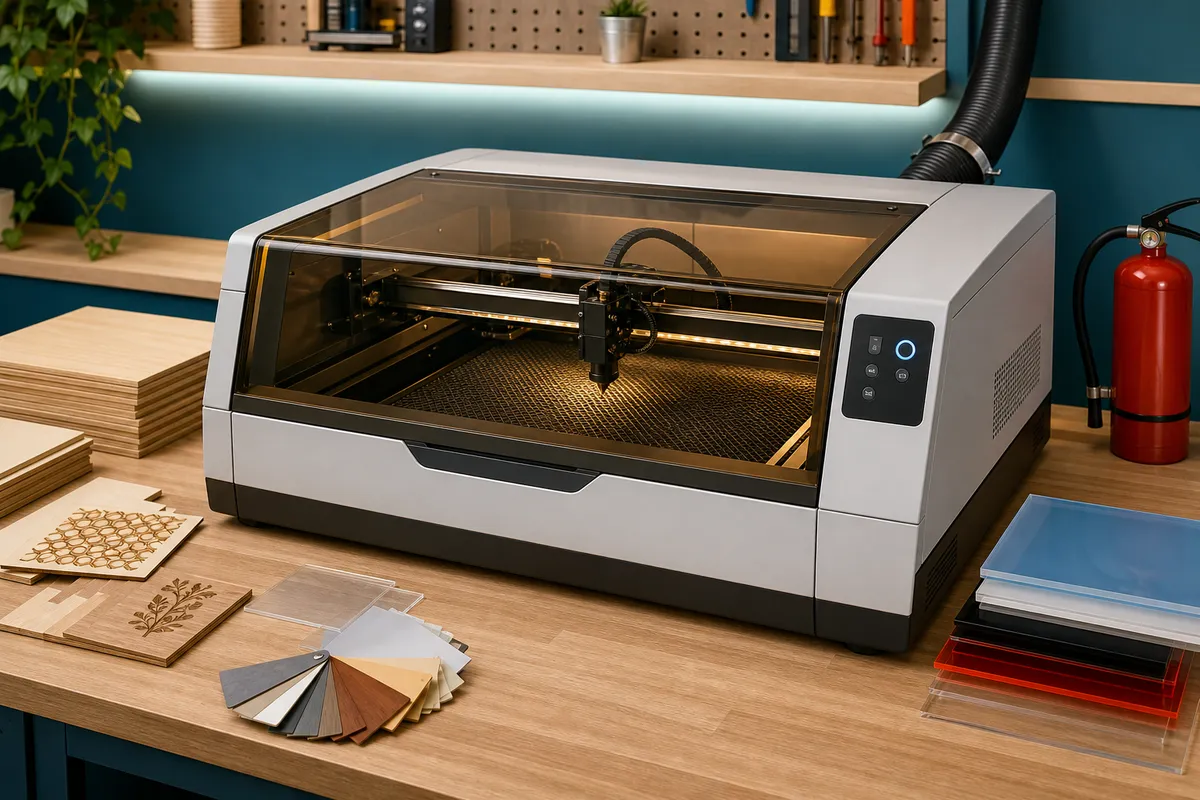
The physics that drives everything
Diode lasers emit visible blue light (~450 nm). Clear and light-colored materials reflect or transmit it — which is why a diode can't cut clear acrylic at any power, and struggles with white and pale stock. CO2 lasers emit far-infrared (10,600 nm), which almost every organic material absorbs regardless of color: clear acrylic, glass engraving, pale woods, all routine.
That single wavelength difference explains most of the table below.
Side by side for a garage
| Diode (10–40 W optical) | CO2 (40–60 W tube class) | |
|---|---|---|
| Usable price | $300–$1,200, plus enclosure/exhaust | $450 (K40, with caveats) to $2,500–$5,000 (cabinet machines) |
| Footprint | Desktop; stores on a shelf | Furniture; it gets a corner of the garage permanently |
| Cuts plywood/basswood | 3–6 mm comfortably, ~10 mm with passes and patience | 6–12 mm in single fast passes |
| Clear acrylic | No. Hard physics limit | Yes — clean flame-polished edges; it's the signature material |
| Engraving speed | Fine for hobby batches | 3–10× faster; the production difference |
| Maintenance | Lens wipe; diodes last years and cost little to replace | Mirror alignment, tube cooling water, tube replacement ($200–$500 every few years) |
| Cooling | Air-cooled, plug and play | Water cooling loop — pump, reservoir or chiller, freeze awareness in cold garages |
Choose a diode if…
- Your projects are wood, leather, slate, cardboard, and coated metals — engraving-heavy with light cutting of 3–6 mm stock.
- Space and budget are real constraints; a diode plus a full accessory setup lands under what a CO2 cabinet costs bare.
- You want near-zero maintenance: no mirrors to align, no water loop, no tube lifetime clock.
- You might want it mobile — craft fairs, classes, or sharing a CNC frame as a module.
Choose a CO2 if…
- Acrylic is in your plans. Earrings, signage, LED edge-lit pieces, enclosures — the entire acrylic product world is CO2-only.
- Throughput matters: you're batching dozens of ornaments or engraving tumbler blanks for a market, and 3× speed is the business case.
- You're ready for the machine to be a station, not a gadget — with a water loop, alignment checks, and a permanent exhaust run.
- A used or entry cabinet machine fits the budget. (The $450 K40 path is real but it's a tinkerer's machine — budget time and upgrades.)
Entry points on each side
10–20 W diode laser kit
The diode-side starting class: enough optical power that cutting 3 mm ply is pleasant, not punishing. Budget the enclosure and exhaust alongside.
See options on Amazon →Desktop CO2 laser (50–60 W cabinet class)
The CO2 tier where acrylic work and real throughput begin — compare bed size, cooling (chiller vs bucket), and included exhaust.
See options on Amazon →CO2 water chiller (CW-3000 class)
If you go CO2 in a garage that sees temperature swings, active cooling protects the tube — the component your tube's lifespan depends on.
See options on Amazon →The third option people forget
If you need CO2 capability four times a year — the occasional acrylic project in a diode-shaped hobby — don't buy the cabinet. Use a shared one. The Makr Lab in Anaheim runs laser cutters members can book, which covers the acrylic projects while your diode handles the weekly wood work. And if it's really a one-off batch, OCreate can cut it for you.
Frequently asked questions
Can any diode laser cut clear acrylic?
No. Clear acrylic transmits 450 nm light instead of absorbing it — power doesn't fix transparency. Black and some dark opaque acrylics cut on strong diodes (with awful fumes management needs), but clear/frosted/pastel acrylic work is the defining CO2 use case.
Is a K40 a good first laser?
It's the cheapest real CO2 — and a project in itself: stock exhaust, bed, and safety interlocks all want upgrading, and alignment is on you. Great for tinkerers who want CO2 physics on a budget; frustrating as a first machine if you just want to make things. A quality diode kit is the smoother entry.
How long do CO2 tubes and diodes actually last?
Hobby-duty CO2 tubes typically give 1,000–3,000 hours over a few years (storage and cooling habits matter); replacements run $200–$500 for common sizes. Diode modules are rated for ~10,000+ hours and cost much less to swap — effectively a non-issue at hobby volume.