CNC fundamentals
CNC Router Bits for Beginners: The Five That Matter
Updated June 11, 2026
You can make ninety percent of beginner CNC projects with five bit types. This guide explains what each one is for, why chip evacuation matters more than sharpness, and gives conservative starting numbers for 4040-class machines.
Some links on this page are affiliate links. If you buy through them, The Maker Guide may earn a small commission at no extra cost to you. We only point at product categories we would compare ourselves. Details.
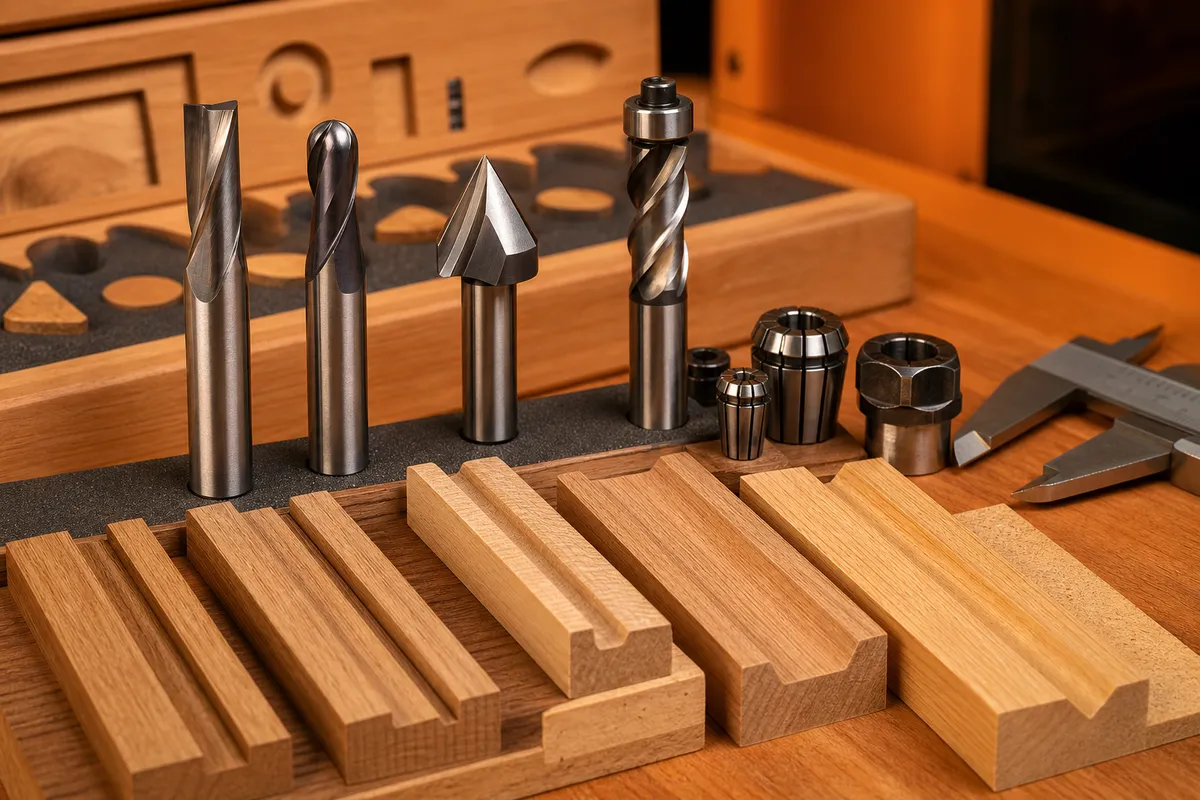
The starter five
| Bit | What it does | Use it for |
|---|---|---|
| 1/8 in upcut endmill (2-flute) | Pulls chips up and out of the cut; leaves a fuzzy top edge | General profiling and pocketing — your default bit |
| 1/8 in downcut endmill | Presses chips down; crisp top surface, heat builds in deep slots | Plywood and anything where the top face shows |
| 1/4 in compression bit | Up-spiral at the tip, down-spiral above: clean top AND bottom | Through-cuts in plywood and melamine once you're past beginner feeds |
| 60° or 90° V-bit | Carves V-grooves of varying width by depth | Lettering, sign making, chamfers — V-carve toolpaths |
| 1 in surfacing bit | Flattens large areas in shallow passes | Truing your spoilboard and flattening slabs/glue-ups |
Chip evacuation is the whole game
Beginner bit problems are almost never sharpness — they are heat. When chips stay in the cut, the bit re-cuts them, friction climbs, the edge burns, and the bit dulls in minutes. That is why slot cuts in deep pockets kill bits and why a dust shoe (our setup guide) is also bit insurance.
Rule of thumb: if the cut produces dust instead of chips, you are feeding too slow or spinning too fast. Powder means heat; small curls mean a happy bit.
Conservative starting numbers (4040-class, wood)
| Operation | Bit | Feed | Depth per pass | Router/spindle |
|---|---|---|---|---|
| Profile in pine/poplar | 1/8 in upcut | 1000–1500 mm/min | 1.5–2 mm | ~18,000 RPM |
| Profile in hardwood (oak, maple) | 1/8 in upcut | 800–1200 mm/min | 1–1.5 mm | ~18,000 RPM |
| Plywood through-cut | 1/8 in downcut | 1000–1400 mm/min | 2 mm | ~18,000 RPM |
| V-carve lettering | 60° V-bit | 1000–1500 mm/min | per toolpath | 16,000–18,000 RPM |
| Spoilboard surfacing | 1 in surfacing | 2000–2500 mm/min | 0.5–1 mm | 12,000–16,000 RPM |
Buying advice that saves money
- Buy a cheap assortment first, then good single bits. A $30 set teaches you which three bits you actually use; replace those with quality carbide (SpeTool, Amana, Whiteside) as they dull.
- Standardize on 1/8 in and 1/4 in shanks and buy collets/adapters once.
- Single-flute bits are the secret for plastics and aluminum on low-rigidity machines — one big chip per revolution clears heat fast.
- Mark your bits' mileage. A strip of tape on the case with a tally of jobs tells you more than squinting at the edge.
Starter kit to compare
1/8 in carbide endmill assortment
Upcut and downcut spirals in one set — the working core of your first fifty projects.
See options on Amazon →V-bit pair (60° + 90°)
V-carving is the highest-perceived-value thing a beginner CNC does (signs, lettering); two angles cover nearly all of it.
See options on Amazon →1 in spoilboard surfacing bit
Your spoilboard must be flat for anything else to be accurate. Surface it when you set up and after heavy use.
See options on Amazon →FoxAlien bit and accessory catalog
If you run a FoxAlien machine, their own bit bundles and collet options are matched to the stock spindles.
Browse FoxAlien accessories →Frequently asked questions
Why do my CNC bits burn the wood?
Heat from re-cutting chips: the feed is too slow for the RPM, the pass is too deep for the chip to escape, or the bit is dull. Speed up the feed, shallow the pass, lower RPM slightly, and clear chips with a dust shoe or air. Burning in cherry and maple shows up first — they are the canaries.
Upcut or downcut for plywood?
Downcut for the show face: it presses the veneer down instead of tearing it. For deep through-cuts, either flip to a compression bit or run a final downcut pass at full depth after an upcut roughing pass.
How long should a carbide bit last?
In clean wood with good chip evacuation, dozens of hours of cutting. In MDF (abrasive glue) or with chips packed in the cut, a fraction of that. Bits are consumables — budget for them like sandpaper, not like tools.