Laser setup
How to Vent a Laser Engraver in a Garage
Updated June 11, 2026
Laser smoke is not woodsmoke nostalgia — it's adhesives, lignin tar, and whatever the material's coating is, condensing onto your optics and lungs. The fix is one airflow path: enclosure → short smooth duct → inline fan → outdoors. Here's how to build it in a garage without remodeling.
Some links on this page are affiliate links. If you buy through them, The Maker Guide may earn a small commission at no extra cost to you. We only point at product categories we would compare ourselves. Details.
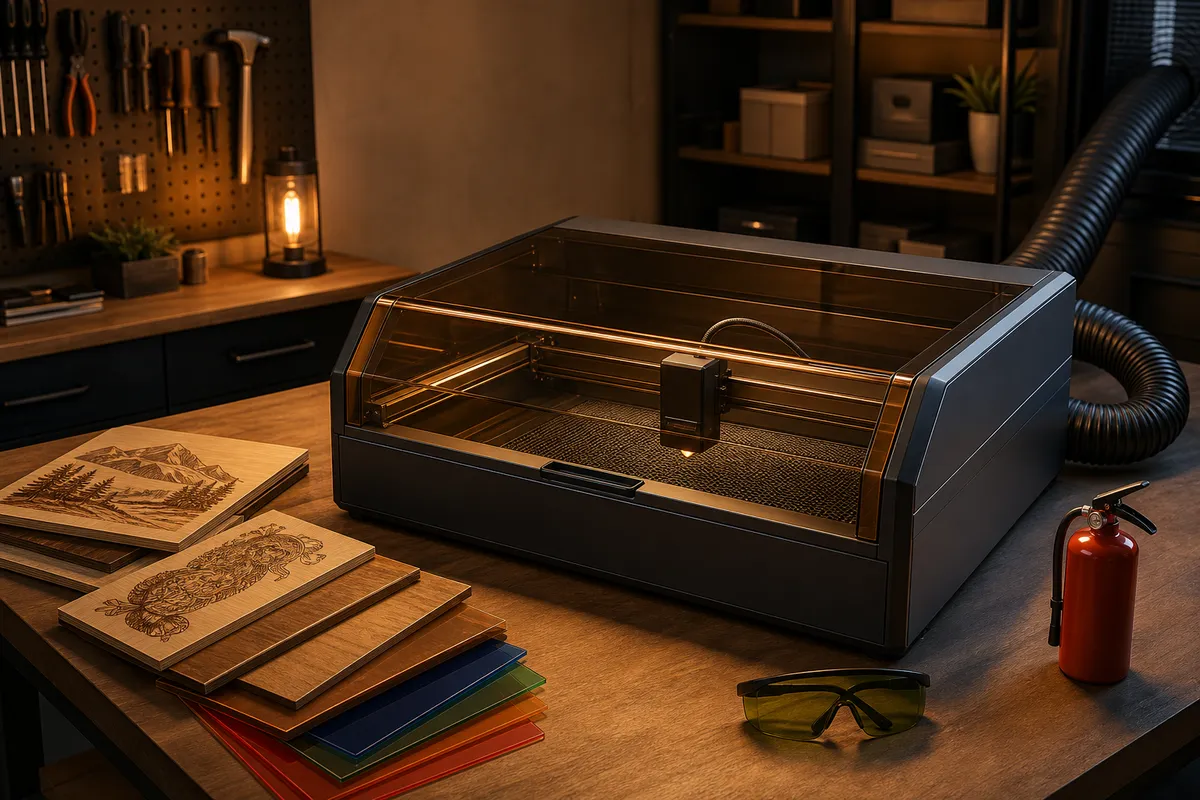
The system in one diagram's worth of words
Air enters the enclosure through its passive intake, sweeps across the work area, and leaves through a 4-inch duct pulled by an inline fan, exiting through a window or door panel. Two details carry the whole design: the duct run is short and smooth (every corrugated foot and every bend costs flow), and the fan sits near the exit, pulling smoke through the duct rather than pushing it — so duct leaks leak inward, not into your garage.
Sizing the fan
| Setup | Fan | Notes |
|---|---|---|
| Diode laser in a hobby enclosure | 4 in inline duct fan, 150–250 CFM | Speed controller is worth it — full power is rarely needed and much louder |
| CO2 laser (K40 to 60 W class) | 4–6 in inline fan, 250–400 CFM | Upgrade the screechy stock fan first; it's the worst part of every K40 |
| Shared/long duct runs | Add ~10% capacity per extra meter or bend | Or better: move the machine closer to the window |
Getting through the window (or door)
The standard garage solutions, in order of preference: a window vent panel (plywood or acrylic cut to the opening with a 4-inch flange — a perfect first CNC or laser project), a casement/slider insert like portable-AC kits use, or a garage-door top-gap panel that sits in one corrugation when the door is cracked. Foam-seal whichever you choose; the goal is that smoke has exactly one way out.
Run the duct downhill or level to the exit if you can — tar condenses in the duct over time, and you want it migrating away from the machine.
Makeup air: the step everyone skips
A fan can only blow out what the room lets back in. In a sealed garage, the exhaust chokes, the enclosure leaks smoke at every seam, and people blame the fan. Crack the door on the far side of the room, or open the garage door an inch — you want a cross-room path so fresh air sweeps toward the laser. If the enclosure bows inward when the fan runs, it's starving; open the intake.
What about carbon filter boxes?
Recirculating carbon/HEPA units (the desktop 'fume extractor' class) are legitimate for light engraving duty and for rooms with no exterior wall. Their honest limits: the carbon saturates quietly (you'll smell it when it's done), replacement cartridges cost real money on a schedule, and heavy cutting overwhelms small units. Outdoors beats filtration every time it's available; filters are the fallback, not the upgrade.
Exhaust shopping list
4 in inline duct fan with speed controller
The heart of the system. Variable speed means quiet engraving sessions and full power for cutting.
See options on Amazon →Aluminum duct + clamps + foil tape
Semi-rigid aluminum beats wire-and-plastic hose: smoother inside, no melting worries near a hot fan, and foil tape seals the joints properly.
See options on Amazon →Window vent panel / AC window kit
A sliding-window seal kit with a 4 in port saves you fabricating the panel — measure your window style first.
See options on Amazon →Smoke detector for the shop
Cheap, obvious, frequently absent from garages. Mount one near (not above) the laser station.
See options on Amazon →Frequently asked questions
Can I run a diode laser indoors without venting if I only engrave?
Engraving makes less smoke than cutting, but 'less' is still resinous particulate in room air, and materials like leatherette make engraving smoke you absolutely don't want indoors. Minimum responsible setup is an enclosure with a duct outside; a filter unit if a window truly doesn't exist.
My exhaust fan runs but smoke still escapes the enclosure — why?
Three usual causes, in order: no makeup air (room is too sealed — crack a far door), duct losses (too long, too many bends, corrugated hose), or the fan mounted at the enclosure pushing instead of near the exit pulling. Negative pressure inside the enclosure is the goal: leaks should flow inward.
How loud is a laser exhaust setup?
A quality 4 in inline fan on a speed controller runs conversation-quiet at engraving flows and 'box fan on high' for cutting. The cheap no-controller fans are the loud ones — the controller is a comfort purchase that makes you actually use the exhaust every session.