Shop projects
3D Printed Shop Organization: A Weekend Plan
Updated June 11, 2026
Shop organization is the highest-ROI thing a 3D printer does, and it works best as a planned weekend, not a parts-bin whim: audit, baseline the drawers, mount the wall tools, put consumables where they're used. Here's the plan with print-time math.
Some links on this page are affiliate links. If you buy through them, The Maker Guide may earn a small commission at no extra cost to you. We only point at product categories we would compare ourselves. Details.
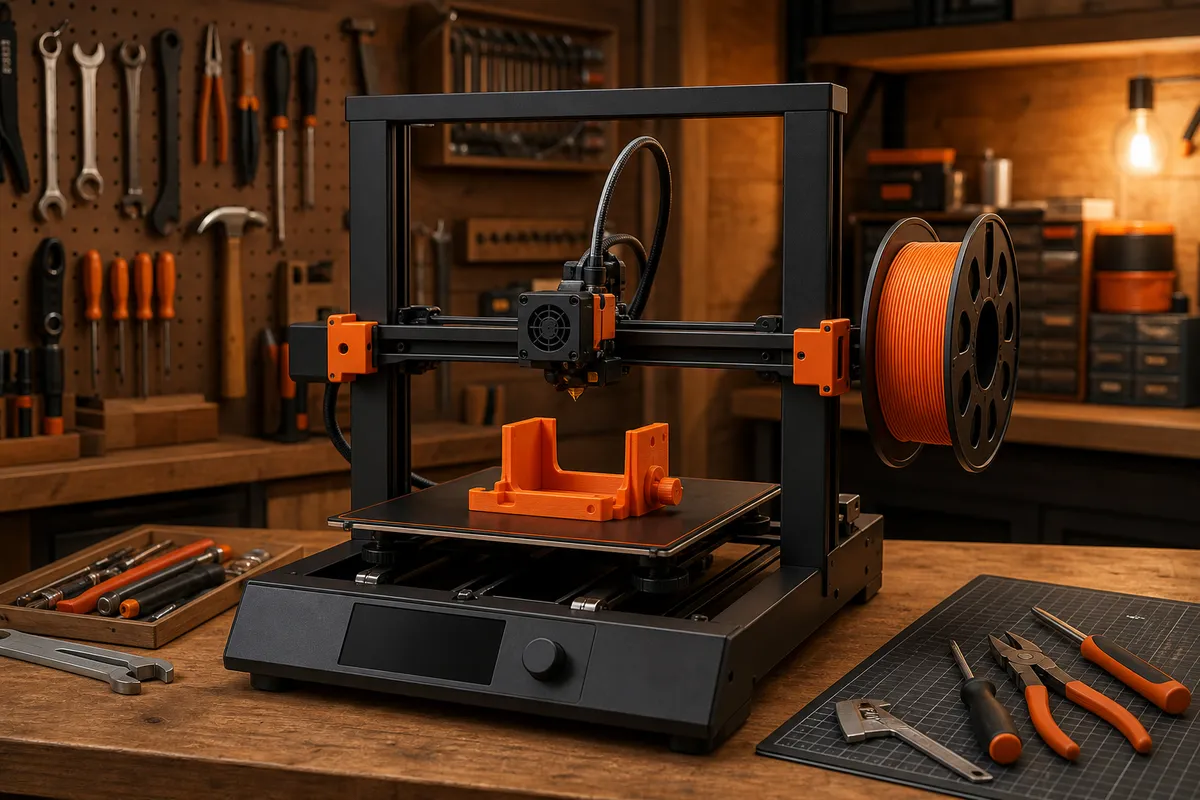
Friday night: the audit and the queue
Walk the shop with your phone and photograph every cluttered surface and drawer. Sort the chaos into three piles of need: small parts (hardware, inserts, bits — Gridfinity territory), hand tools (wall-holder territory), and consumables at point of use (caddy territory). Then load the print queue tonight — organization prints are long and unattended, perfect for printing while you sleep.
Print-time reality: a 5×5 Gridfinity baseplate runs ~3–5 hours; bins run 1–3 hours each. A drawer's worth is a weekend of background printing, which is why the queue starts Friday.
Saturday: drawers (the compounding win)
Gridfinity-style modular bins are the rare standard that earned its hype: a printed baseplate grids each drawer, bins snap into it, and from then on storage evolves — new tool, print a bin, done. Start with the drawer you open most (usually hardware), measure it, and print baseplates to fit.
Two upgrade decisions worth making now: magnets in bin bases if bins will travel to the bench (skip them for stay-home drawers — it's a lot of magnet gluing), and a label standard (embossed text prints free; label-maker tape reads better). Sort hardware while bins print — the sorting is the real work and the printer can't do it for you.
Sunday: walls and point-of-use
Hand tools go visible: printed holders on pegboard or a French cleat rail — calipers first (the most-reached-for tool in any maker shop), then pliers, drivers, and the bit organizers for CNC and driver bits. Print holders in PETG if the wall is near a sunny window or warm machine; PLA sags eventually.
Then consumables move to where they're used: a caddy of inserts and screws at the assembly bench, sandpaper rack by the finishing zone, laser hold-downs in a bin at the laser, CA glue and tape at the CNC. The principle: if you walk for it twice a session, it needs a printed home within arm's reach.
The math that justifies it
A weekend plus roughly 2 kg of filament (~$30–40) organizes a one-car-garage shop. Compare against drawer organizers and tool holders bought retail ($150+ for worse fit), but the real return is time: minutes-per-session saved hunting, multiplied by every future session. Organization prints are also the perfect first functional prints for new printer owners — low risk, immediate payoff, and they teach tolerances.
The non-printed parts
6×2 mm magnets (bulk)
The Gridfinity standard for bins that travel; buy 100+, you'll use them on every printed fixture after this too.
See options on Amazon →Pegboard or French cleat hardware
Printed holders need a wall system to live on — either standard works with the model libraries.
See options on Amazon →Label maker tape (or a label maker)
Embossed printed labels are free but low-contrast; tape labels keep a sorted shop sorted.
See options on Amazon →PLA in bulk
Organization eats filament; boring gray bought in 2–3 kg lots is the right fuel.
See options on Amazon →Frequently asked questions
Is Gridfinity worth it over just buying drawer organizers?
If you own a printer, yes — fit is exact, the system grows with the shop, and cost is filament. If you don't own a printer, retail organizers win on time; or print a starter set at a makerspace and decide with evidence.
How much filament does organizing a shop take?
Plan ~2 kg for a serious first pass: baseplates are the hungry part (a drawer's plates can be 300–500 g), bins are 30–80 g each, wall holders 20–60 g. Print plates in draft quality — they're invisible infrastructure.
PLA or PETG for shop organization?
PLA for everything in drawers and on temperate walls — stiffer, cheaper, prints faster. PETG only where heat or sun lives: near printer enclosures, sunny windows, or the garage ceiling in summer.