Tool guide
Electronics Workbench Essentials: The $200 Bench That Debugs Anything
Updated July 7, 2026
An electronics bench isn't one big purchase — it's about eight small ones, and the order matters. A $30 multimeter answers more questions than a $300 oscilloscope for the first two years; a bench supply prevents more dead boards than any amount of care. Here's the bench in tiers, with the skip-list.
Some links on this page are affiliate links. If you buy through them, The Maker Guide may earn a small commission at no extra cost to you. We only point at product categories we would compare ourselves. Details.
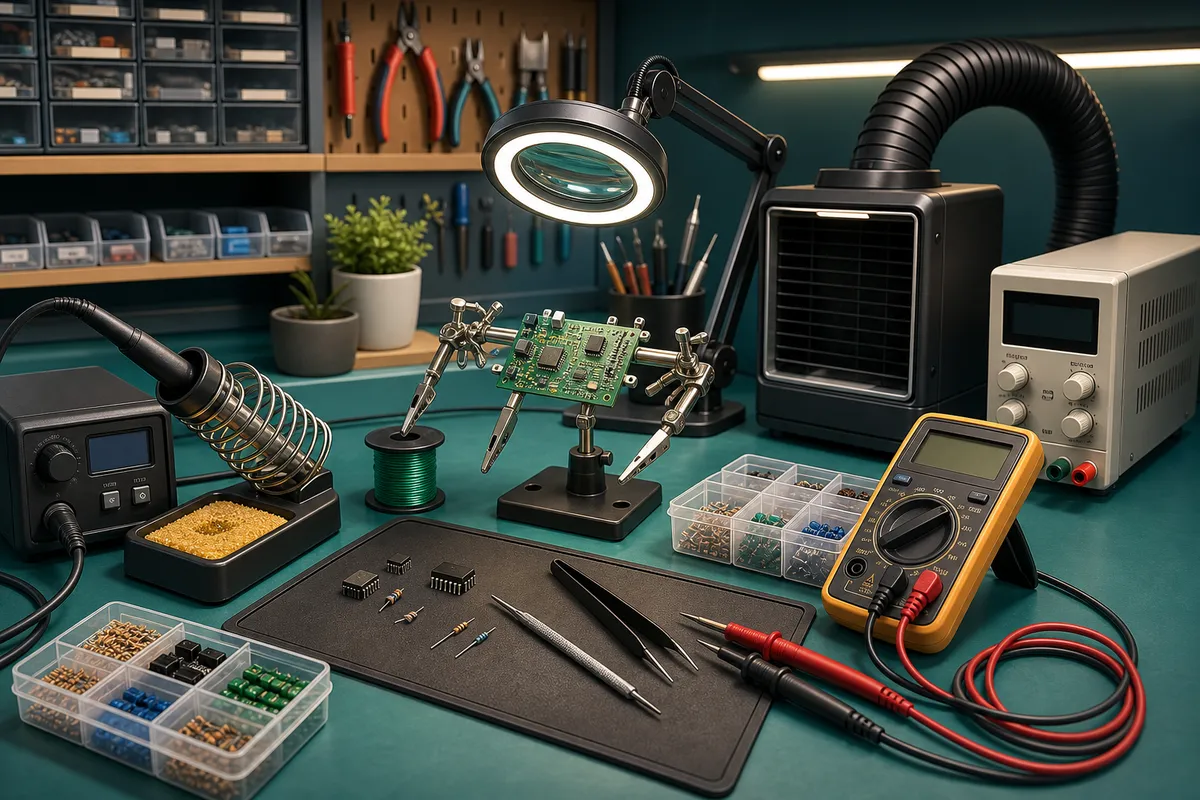
Tier 1 — the debugging core (~$100)
Auto-ranging digital multimeter
The one tool electronics can't happen without: continuity (the beep finds broken wires and bad joints — 80% of all use), voltage, resistance, and diode test. A $30–50 name-brand auto-ranging meter (AstroAI/Klein class) covers hobby life; the $200 Fluke is for when it's your profession.
See options on Amazon →Soldering setup
Covered fully in our soldering iron guide: Pinecil-class iron, real solder, flux pen, brass wool. ~$60 all-in and permanently sufficient.
See options on Amazon →Flush cutters + wire strippers (gauged)
The two hand tools in constant motion. Gauged strippers (20–30 AWG for electronics) beat the guess-and-nick universal kind; flush cutters trim leads and are shared property with the 3D printer bench.
See options on Amazon →Helping hands / PCB holder with magnifier
Soldering requires three hands; this is the third. The base-plus-flexible-arms style with a lens handles boards, wires, and aging eyes in one $25 tool.
See options on Amazon →Tier 2 — power and prevention (~$100)
Bench power supply (30 V / 5–10 A, current limited)
The most underrated purchase on this page: current limiting means a wiring mistake draws a capped 100 mA and reveals itself, instead of releasing the magic smoke. Powers every project without hunting wall warts; the display doubles as a crude diagnostic.
See options on Amazon →USB power meter + assorted supply modules
USB-C PD trigger boards and a $12 inline USB meter answer 'is this getting power?' for the modern-parts world where everything runs on 5 V anyway.
See options on Amazon →Small fume extractor or fan
Flux smoke rises directly into the face bent over the joint. A $30 filtered fan (or any fan pulling smoke sideways) fixes the stinging-eyes tax on long sessions.
See options on Amazon →Silicone soldering mat
Heat-proof, ESD-conscious, and its parts trays catch the screws that otherwise fund the floor. Doubles as the honest signal of where the electronics zone begins on a shared bench.
See options on Amazon →Tier 3: buy when a project demands it
Oscilloscope — the internet's favorite over-recommendation. Glorious for audio, signals, and 'why is this flaky' mysteries; irrelevant for LED strips and sensor projects. When the day comes, $300 entry Rigol/Siglent scopes (or a $70 USB scope for gentle use) are better than any vintage boat anchor. Logic analyzer — a $15 8-channel clone plus free software decodes I2C/SPI arguments with sensors; buy it the first time a datasheet fight breaks out. Hot air / rework — for SMD and salvage, with your second iron upgrade. Label maker and drawer organizers — mock if you like, but the bench with labeled part drawers is the bench that finishes projects.
The through-line: tier 3 tools answer questions you don't have yet. Let a real project pull each one onto the bench.
The bench itself
Requirements are humble: a meter of desk, an outlet strip mounted at bench level (crawling under for plugs gets old by day two), the brightest lamp you can stand, and separation from the dusty side of the shop — CNC dust and open electronics are bad roommates, which is why makerspaces wall the electronics lab off. Speaking of which: the fastest way to learn what a well-equipped bench feels like is to use one — The Makr Lab's electronics benches come stocked, staffed, and pre-organized, which is excellent market research for your own.
Frequently asked questions
What should I buy first for an electronics bench?
Multimeter, then soldering setup, then the hand-tool pair — in that order, about $120 total. The multimeter leads because debugging starts before building does: half of early electronics is discovering which wire, joint, or battery isn't what it claims.
Do I really need a bench power supply?
'Need' arrives the first time a miswired board dies on a full-current USB port. Current limiting turns fatal mistakes into blinking numbers — for $60–80, it's the cheapest insurance in the hobby. Until then, USB power plus a $12 inline meter is a legitimate starter stack for 5 V projects.
Is a cheap multimeter safe and accurate enough?
For electronics-bench work (low voltage DC, continuity, resistance): yes, $30 name-brand meters are accurate beyond hobby needs. The safety caveat applies to mains work — measuring wall power wants a meter with real CAT III ratings, and honestly, beginner projects should stay off mains entirely.
When does an oscilloscope make sense?
When you're debugging signals rather than circuits: audio paths, PWM behavior, sensor waveforms, communication glitches. If your projects are sensors-and-relays automation, a logic analyzer ($15) plus serial print statements answers most questions a scope would. No shame in year three scope ownership.
How do I keep components organized without going full warehouse?
One rule and one habit: every part type gets a labeled home the day it arrives (drawer cabinets for actives, binder-style SMD books, printed trays), and orders happen in themed batches rather than one-offs. The bench that skips this rebuys its own inventory quarterly — ask anyone.