CNC bits
V-Bits and V-Carving: The Bit Choice That Makes Signs Look Professional
Updated July 7, 2026
V-carving is the trick that makes a $300 CNC produce work people assume came from a $30,000 one: the software varies cut depth so a single V-bit renders any letterform, serif or script, at any size. The machine does the magic — your only real decision is the bit angle.
Some links on this page are affiliate links. If you buy through them, The Maker Guide may earn a small commission at no extra cost to you. We only point at product categories we would compare ourselves. Details.
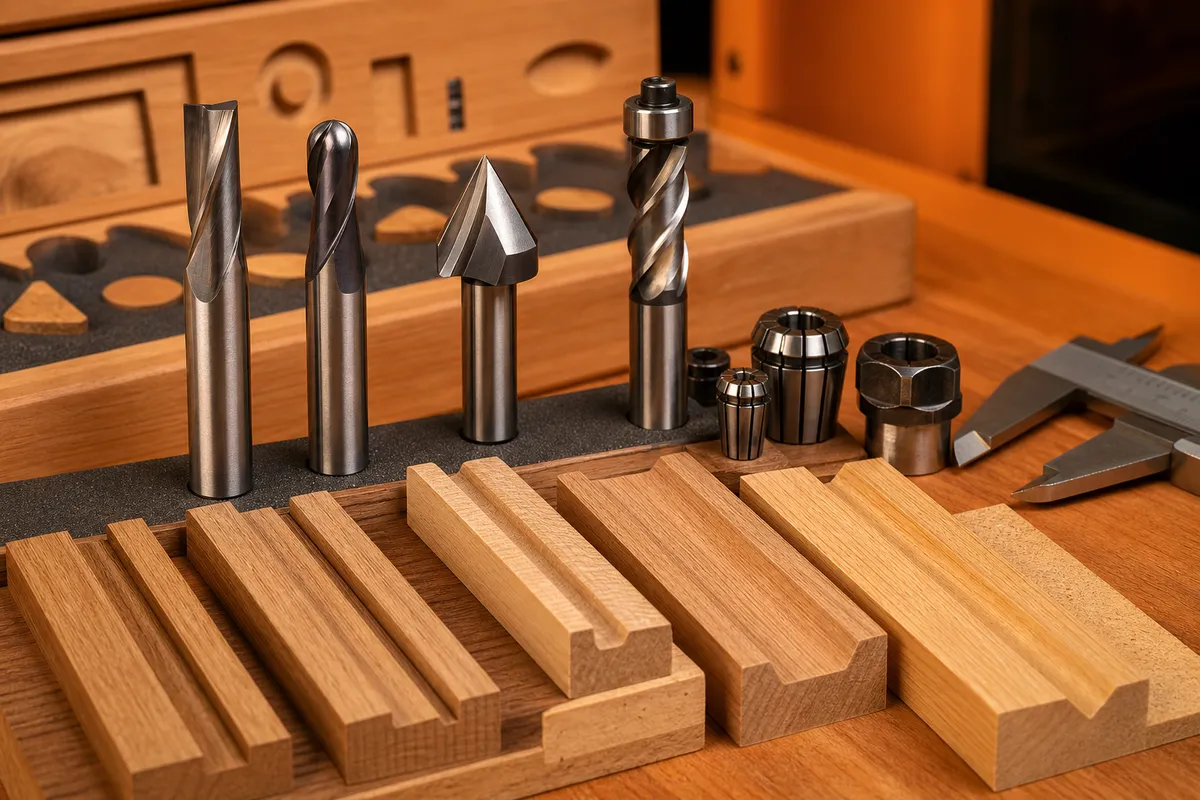
How V-carving actually works
A V-carve toolpath drives the bit deeper where the design is wide and shallower where it is narrow, so the V's sloped walls always meet the outline of the artwork. That is why one bit renders a whole font, and why a chipped tip ruins everything — the tip cuts every centerline of every letter.
The angle sets the look: a narrow angle carves deep, dramatic grooves; a wide angle carves shallow and broad. It also caps letter size — a 60° bit needs about 0.87× the letter stroke width in depth, so tall letters may bottom out against your material thickness or your machine's Z travel.
Which angle for which work
| Angle | Lettering sweet spot | Character | Watch out for |
|---|---|---|---|
| 30° | Tiny text, fine detail under 10 mm | Deep, narrow, fragile tip | Snaps easily; fuzzy in softwoods |
| 60° | 10–30 mm letters, detailed ornaments | Crisp and deep — the classic sign look | Depth may exceed thin stock on big strokes |
| 90° | 25–60 mm letters, general purpose | Balanced; the one-bit answer | Fine serifs render slightly soft |
| 120° | Large letters, shallow wide carves, chamfers | Broad and shallow | Looks flat on small text |
Buy for the tip, not the brand
The whole job passes through the last 0.5 mm of the bit, so tip grind quality is the spec that matters. Two practical consequences: first, inspect a new V-bit with a loupe or macro phone photo — a factory-chipped tip is the most common cause of a mysterious ragged centerline. Second, never plunge a V-bit straight down at full speed into hardwood; ramp in or let the V-carve toolpath's shallow start protect it.
Bits with a small flat at the tip (engraving-style 'tipped' V-bits, often 0.1–0.2 mm) are sturdier and fine for most sign work — but tell your CAM software the flat's width, or shallow details will carve wider than drawn.
The V-carving starter drawer
90° V-bit, 1/2 in cutting diameter
The first V-bit: handles the widest range of letter sizes and doubles as a chamfer bit for easing part edges.
1/4 in shank
See options on Amazon →60° V-bit
The detail bit — crisper serifs and small text than the 90° can render. Most finished signs use both in one job.
1/4 in shank
See options on Amazon →30° engraving bits (10-pack)
For text under 10 mm and PCB-style fine work. They snap — that's why they come in ten-packs. Budget accordingly.
See options on Amazon →1/4 in downcut spiral
Most sign jobs pocket the background or cut the profile too — pair every V-carve with a clean-top-face spiral.
See options on Amazon →Loupe or 10x jeweler's magnifier
Five dollars of glass that diagnoses the number-one V-carve defect: a chipped tip you can't see with the naked eye.
See options on Amazon →Why V-carves come out ragged (in order of likelihood)
- Z zero is off. V-carving is brutally sensitive to Z — 0.2 mm too deep makes every letter fat. Zero on the actual stock surface, not the spoilboard, and consider a touch probe if you carve often.
- Stock isn't flat. A cupped board varies the effective depth across the sign. Surface the blank, or shim and re-check with a straightedge.
- The tip is chipped. See the loupe above. Replace, don't resharpen — hobby V-bit geometry doesn't survive hand sharpening.
- Wrong wood. Open-grain softwoods (construction pine) fuzz in fine detail no matter the bit. Maple, cherry, and walnut carve like butter; MDF carves crisp but drinks paint.
- Feed too fast for the tiny tip. The tip's cutting speed approaches zero at the centerline; if edges burn or fuzz only in the finest strokes, slow the feed 20%.
The money angle
V-carved signs are consistently the highest-margin item a hobby CNC produces: $10 of hardwood and 40 minutes of machine time sells for $60–150 personalized. If you want to test the workflow before buying bits, the CNC machines at The Makr Lab run V-carve jobs regularly and someone there has already made every mistake on this page.
Frequently asked questions
What's the difference between a V-bit and an engraving bit?
Geometry-wise they're cousins. 'V-bit' usually means a solid-carbide or brazed-tip groove bit (1/4–1/2 in diameter) for wood signage; 'engraving bit' usually means a small, often tipped, 10–30° tool for fine text and metal marking. For 15 mm+ lettering in wood, you want the V-bit.
Can I V-carve plywood or MDF?
MDF carves crisply and paints beautifully once sealed (shellac or sanding sealer first, or it drinks topcoat forever). Plywood is the worst V-carve material — the carve exposes alternating veneer layers as stripes through every letter. Solid wood or MDF, not ply.
What speed and feed should I start with for a 90° V-bit?
In hardwood on a 4040-class machine: roughly 1000 mm/min feed, full spindle speed, max pass depth around 3 mm, and let the CAM's V-carve strategy manage depth. Softwoods can go faster; start conservative and listen — chatter means slow down or shallower.
Why do my carved letters have flat, wide bottoms?
Either your CAM thinks the bit is sharper than it is (set the actual tip-flat width for tipped bits), or a 'flat depth' limit is set in the V-carve toolpath and big letter strokes are hitting it. Both are software settings, not machine faults.
Do I need a special spindle or machine for V-carving?
No — V-carving is light-duty cutting, well within any 3018-and-up machine. What it does demand is accurate Z and flat stock. Even a $200 machine V-carves impressively if you zero carefully.